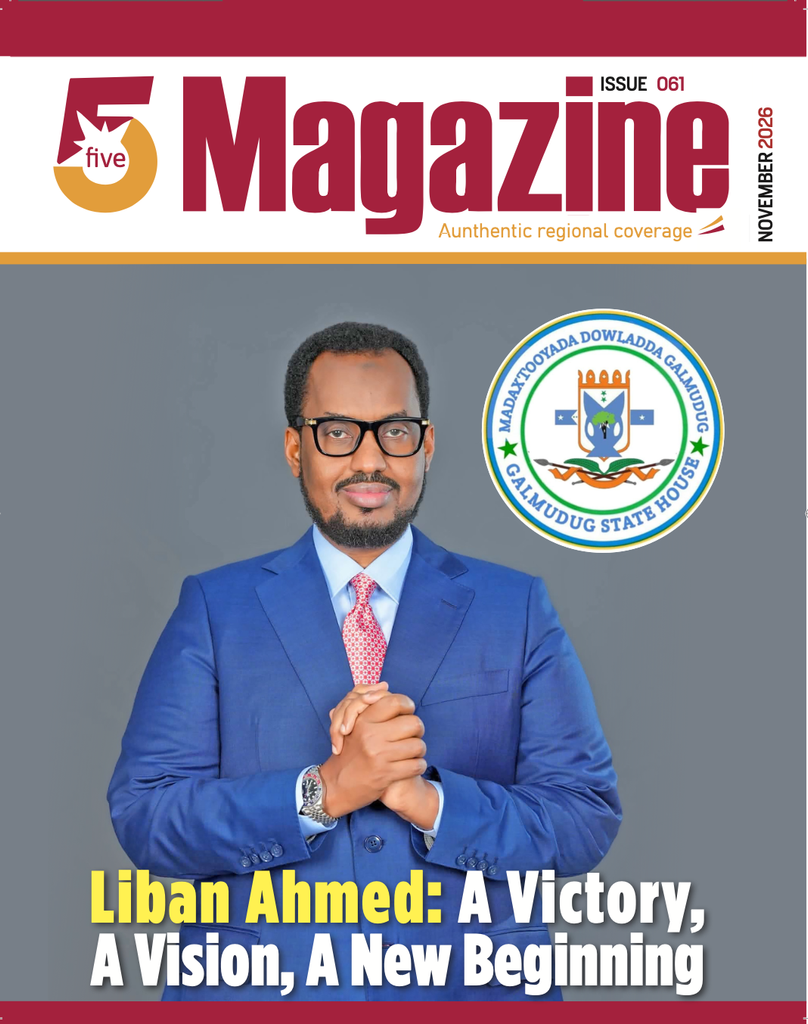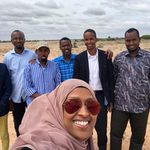
By Ilham Gassar, Member of the East African Legislative Assembly
When I landed in Dhusamareeb to witness the election of Liban Ahmed Hassan, I felt joy, but also memory. The hardship and heartache of the years behind us were in that room too. The seventy-two votes he won, an overwhelming majority, were a verdict not only on a candidate, but on everything Galmudug has lived through. And I could not help thinking of the first time we landed there together.
That was on 31 May 2019, years after Liban and I first worked together on the 2016 Galmudug and Puntland peace process. My work on Galmudug had begun that same year, when it was a divided state, run as two administrations from two cities. Dhusamareeb, its constitutional capital, was not functioning. Ahlu Sunna Wal Jama’a held it and did not want the Galmudug administration established in Adado to govern from there. President Xaaf’s leadership was focused on ending that division: moving the temporary capital from Adado to Dhusamareeb, bringing Ahlu Sunna and the different factions on board, and making Galmudug one. He succeeded. Our work was part of that effort.
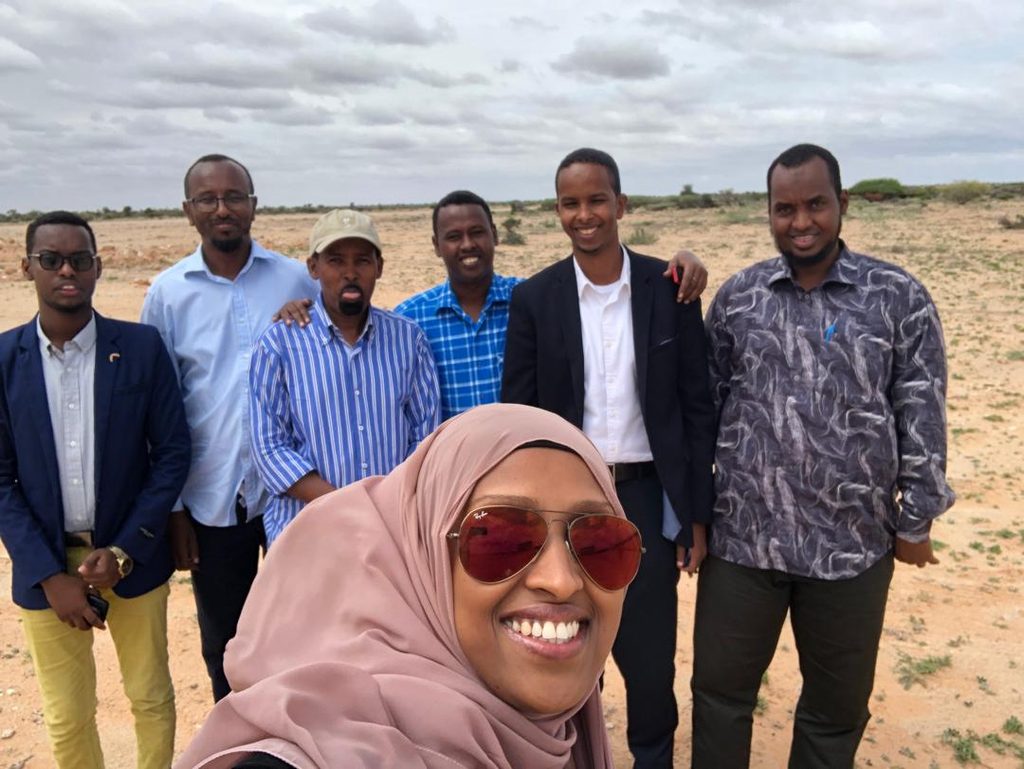
My own mission was harder to reach. Dhusamareeb was difficult terrain, with few guarantees for anyone operating from outside, so I took on the task of going there myself. As a UN Political Affairs Officer, I was there to assess whether a state capital could be established, and I could go because I am Somali. I left the UN security behind. And I went looking for Liban. Some had seen him as a spoiler at the beginning. I saw a key figure who could bring peace and prosperity to Galmudug. He was on no payroll and held no office. I simply asked him. I told him I wanted to go to Dhusamareeb, so that our international partners and the UN family could assess how to make the state look like a state, with the structures it needed.
One of those structures was the airport itself. It had no fencing and no tarmac, only a gravel strip. We landed there together on 31 May 2019, the two of us. He held no office and no title, but he was my shield. That day we identified the site of the current State House, and where the institutions of a state could be built.
It was the twenty-seventh night of Ramadan. The plan was to travel the next morning by road from Dhusamareeb to Galkayo, to see the state as it really was and to make a general assessment of its resources, the water and grazing land that people fight over. An international staff member on that road would also have lowered the security risk, a quiet signal that peace was within reach. But on that first night in Dhusamareeb, the security officer who was due to travel from Galkayo to join me in the morning was killed by Al-Shabaab. My mission was cut short.
What was not cut short was our vision. Liban and I both wanted a state that represented us, and that night did not end that wish. It sharpened it. For me, as someone who hails from Galmudug, it was never only a mission. It was personal, and it made every effort extra special. Everything that has followed, including this election, has been a way of keeping faith with that vision.
Where it began
When I first came to Somalia as a UN political advisor to the SRSG, the odds were against me. Everything was politics, everywhere, including inside the UN offices, where senior positions were almost entirely held by men. I was assigned to Galkayo at a moment when a new civil war felt close.
Galkayo is the fault line between Hawiya and Darod, and the border town between Galmudug and Puntland. Elections were approaching. Puntland had severed ties with the centre, as it has again now, and argued that Galmudug was not a full state under the constitution, since it held one and a half regions rather than two or more. Beneath the constitutional argument, Galkayo was being used as a proxy battleground between Puntland and the centre.
To make peace there, I knew I needed to find the real actors. Not only the known political figures, but people on both sides with local influence who could drive change from within. Liban was one of those on the Galmudug side. He held no title and no office. What he commanded was the respect of his people, and I recognised him as a key interconnector who could lift the negotiations to a better level.
Before we met, Liban and I had already bumped heads. Each of us believed the other stood on the opposite side. We were wrong. The moment we sat down together, we understood that we were on the same mission, and from then on, we worked together to achieve it.
Our friendship grew inside a small group, a family of people who each wore a different hat and carried a different kind of weight. I carried international weight. Others carried local influence, or the weight of governance and the security forces. Together we were a team, and we pledged to unite the two Galkayos and to create the opportunity to lead the changes we wanted to see.
Not all of us are here to see this day. On 18 December 2020, a terror attack at the Galkayo Stadium took four of our friends, men who had helped bring peace to the city:
- Colonel Mukhtar Abdi Aden, regional commander of the Danab Brigade, Galmudug Division
- Major Dhamme Abdirahman Mire Ali, known as Marsho, deputy commander of the Danab Brigade
- General Abdiaziz Abdullahi Qooje, known as Dagaari, commander of the 21st Division of the Somali National Army
- Mohamud Yasin Ahmed, known as Tumey, former mayor of North Galkayo
Some of us survive: Colonel Muhidin Bariyow (PSF), Liban and I, with a few others who still carry the hope. What Liban has become is the fruit of that team. When I think of this election, I think of all of us, and of the four who are not here. May Allah have mercy on them. We carry their pledge forward.
A reputation before a handshake
I knew Liban by reputation before we ever met. In those years, I led the Galmudug portfolio on the international community side. Somalis have a name for that community: Beesha 6, the sixth clan in the 4.5 formula that has long shaped Somali power-sharing. I came with that machinery behind me, with its resources, its mandates and its weight.
Liban had none of it, and he did not need it. He was a businessman, a tycoon who had worked with governments and carried real influence among his own people. In Galmudug, they said he built presidents, and that what he said went. Someone with that standing, and no office to defend, is exactly the sort of figure an international envoy must find a way to engage.
The work of reconciliation
Our partnership grew through the hardest work in Galmudug: reconciliation. We worked together on the reconciliation processes between Galmudug and Puntland, a task that tests patience more than strategy. Trust in Somalia is not built at conferences. It is rebuilt one elder, one conversation, and one shared meal at a time, and it can be lost in a single careless sentence.
The work went well beyond agreements on paper. Between November 2016 and the end of 2018, we did not stop at reconciling the two sides of Galkayo. We trained 400 police officers, 200 from each side of the city, in joint courses so that they could patrol together and run joint operations to secure the peace. The first 200 were trained on the northern side. The south had less infrastructure and less established governance structures, and it was there that Liban’s commitment made the difference. He provided the training venue and accommodated the second 200, so that the two groups could stand together as one joint police force.
Beyond the training, Liban and I made a pact that the peace would last, and that the community, not anyone else, would be its beneficiary. I saw him as a key resource in that work, and I promised to do my part: to lobby partners for support, so that both Galkayos would stand on an equal platform when resources were shared. Through peace dividends, I pledged to seek support from partners, among them the Somali Stability Fund, which declared through the UN offices that it would back peace dividends, to build a joint police force and to give it the training and resources it needed. I also committed to support the stadiums, and to build connecting roads and places where joint activities could happen, to increase trade and investment.
Some of that we delivered. We secured funds to build key roads in Galkayo that connect the two sides, and we raised funds for a marketplace to increase trade between the two communities. From my side, I drew the attention of the international community to Galkayo and to the peace dividend it deserved.
What I learned about Liban in those rooms is what I want readers to understand. He does not treat reconciliation as a process to be managed. He treats it as a relationship to be earned. He listens before he speaks. He knows who must be in the room, who must be consulted before the room is even convened, and who must be thanked afterwards.
Of the ground, not above it
Liban comes from Galkayo, from Mudug, the heart of the very terrain on which these questions are fought. Outsiders study that terrain. He grew up inside it.
But his understanding does not stop at his own clan or his own district. He grasps the clan dynamics of Somalis as a whole: how a grievance in one community echoes in another, how a settlement in one district can unsettle a neighbour, how every clan weighs its standing against every other. In Somalia, no clan lives alone, and no peace holds if one party is left outside it. His instinct is always to widen the circle, never to narrow it.
The neighbour who must be brought in
Nowhere is this more important than with Puntland. Galmudug and Puntland share a border, a history and a hard lesson: when relations sour, it is ordinary people in Mudug and Galkayo who pay, in lost livelihoods, in closed roads and in lives. When relations are stable, both sides benefit.
Having worked on that reconciliation with him, I know that Liban does not see Puntland as a rival to be contained. He sees a neighbour whose stability is bound up with his own. A president who sees it that way can turn a frontier of suspicion into a frontier of cooperation. That is not a favour to Puntland. It is in Galmudug’s own interest.
A leader who unites
Somalia today is divided, between Mogadishu and the federal member states, between government and opposition. The process that brought Liban to office was itself contested, and I will not pretend otherwise.
Yet on one question, remarkably, rivals agree: that Liban should lead Galmudug, and that Galmudug must be secured. Federal institutions, other member states and opposition groups, who agree on almost nothing else, converge on this. He unites the young and the old, and opposition leaders well beyond Galmudug’s borders. In a political landscape where every consensus is fragile, a leader who can hold one is worth backing.
A doer, on security and reconciliation alike
Al-Shabaab and other terrorist pockets remain within Galmudug, and clearing them is the first duty of any government that wants its people to prosper.
Liban understands that this fight is won on two fronts at once. He understands the military aspect: the need for capable forces, coordination, and credible command. And he understands the reconciliation aspect: that extremists thrive wherever communities feel excluded or unprotected, and that every settled dispute removes ground from beneath them. Force without reconciliation produces gains that do not last. Reconciliation without security produces peace that does not hold. Liban has spent years in the place where the two meet. He is, above all, a doer.
Beyond Somalia’s borders
Galmudug does not exist in isolation, and neither does its president. Here Liban brings something unusual. As an individual, he carries no baggage with Ethiopia or Kenya. There are no tensions, no history of aggression, and no grievances to be managed. He can engage both from a clean slate.
That matters, because regional support is not a luxury for Galmudug. It shapes security cooperation, trade, and the diplomatic space in which any Somali state must operate. A leader who can draw on goodwill from Addis Ababa and Nairobi, while working constructively with Puntland and Mogadishu, can bring resources and recognition that Galmudug’s people have long deserved.
As a legislator in the East African Legislative Assembly, where much of my work concerns trade and regional integration, I can say that the region increasingly values partners who are predictable, pragmatic and able to deliver. Does his ability to unite stop at Somalia’s borders? I believe it does not. A leader who can bring together clans, neighbours and rival camps at home is well placed to be a credible voice in the wider conversation about the Horn of Africa.
Gravitas without an office
Liban never needed a title to wield influence. For years he was the machinery behind Galmudug’s successes and its struggles, working from outside government. Now he steps into the front seat, with a mandate of seventy-two votes and the standing to bring everyone on board.
The road ahead
I will not pretend the road is easy. Expectations are enormous, and the divisions across Somalia are real. But the first test of leadership is whether people who disagree on almost everything can still agree on you. On that test, Liban has already passed.
What this moment asks of all of us
Liban’s election is not only Galmudug’s moment. It is a test for everyone who has a stake in Somalia’s future, from Mogadishu to the federal member states, from Puntland to the region’s capitals, and the international community that has long walked beside Somalis on this road.
On 31 May 2019, a plane landed at Dhusamareeb Airport, in a town where a capital was meant to be, and a state was still working to hold itself together. Nobody then could have promised that one day it would host a united Galmudug, or that the man beside me would be elected its president by an overwhelming majority.
That is the lesson I take from this journey. Peace in Somalia is not built from the top down or from the outside in. It is built by people who are willing to go first, to land where the ground is uncertain, and to stand beside others when there is no guarantee. Liban was one of those people long before he held any office.
Now he has the mandate. What he needs from us is patience, partnership, and honesty. Honesty about the challenges, and partnership that respects Somali leadership instead of replacing it.
Galmudug has waited a long time for this day. I was there at the beginning, and I was there to see it arrive.
Congratulations, Mr. President. The work begins.