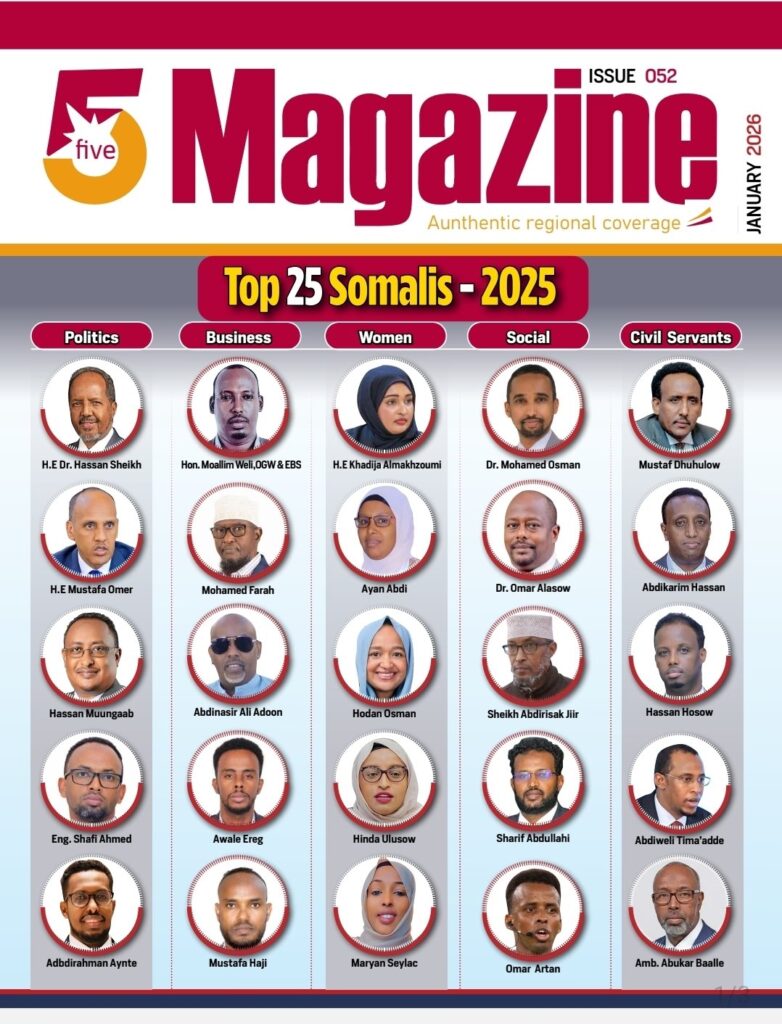
In mid-January 2026, 5 Magazine officially released its annual Top 25 Somalis of the Year list for 2025. First inaugurated in 2023, the initiative reached its third edition in 2025 and has since become a widely anticipated benchmark for recognizing Somali leadership, innovation, and impact across multiple sectors.
As in previous years, the magazine identified the 25 most influential Somalis by organizing them into five key categories: Politics, Business, Social Impact, Women, and Civil Service, with five individuals selected in each category. The final list was distilled from an initial pool of 100 nominees—20 from each sector—through a rigorous selection process that evaluated measurable impact, leadership, and national or regional influence.
Politics
The Politics category was led by President Hassan Sheikh Mohamud, President of the Federal Republic of Somalia. In 2025, one of his administration’s central priorities was judicial reform and the strengthening of the rule of law. In January, he inaugurated the 7th National Judiciary Conference, emphasizing the urgent need to finalize and review Chapter 9 of the Provisional Constitution to establish a justice system that reflects the needs of Somali citizens and supports national recovery.
President Hassan Sheikh Mohamud also highlighted several landmark achievements during the year, including improved security in Mogadishu, large-scale infrastructure investments that created employment opportunities for youth, the construction of new stadiums and airports, the expansion and doubling of national security forces, the recruitment of 6,000 new teachers with plans to reach 10,000, and the revitalization of higher education—particularly at the Somali National University.
Second in the category was Mustafa Mohamed Omar, President of Ethiopia’s Somali Regional State. One of the most tangible achievements of 2025 under his leadership was the expansion of access to clean water. In September, the Somali Regional Government formalized a USD 6.2 million partnership with the United Nations Development Programme (UNDP) and the Children’s Investment Fund Foundation (CIFF) under the Groundwater Access Facility for Africa (GAFA). The initiative will establish 20 new boreholes using advanced drilling and solar-powered systems, benefiting households, 34 health facilities, and 59 schools across Jigjiga, Dhanaan, Birkot, and Dhagahbour.
Third was Hassan Mohamed Hussein (Muungaab), Mayor of Mogadishu. His most consequential achievement in 2025 was advancing direct one-person, one-vote elections in Banadir, marking the first such exercise in over half a century. This milestone restored civic participation in the capital, advanced efforts to resolve Mogadishu’s governance status, and represented a concrete step toward broader democratization in Somalia.
Fourth place went to Eng. Shafi Ahmed Maalim, Mayor of Jigjiga. In 2025, he played a central role in implementing the Jigjiga Corridor Development Project, a transformative urban initiative aimed at modernizing mobility, strengthening economic connectivity, and introducing coherent urban planning. He also led major public service reforms, including the establishment and full operationalization of five sub-city administrations, each with complete leadership structures and service delivery systems.
The category was rounded off by Abdirahman Aynte, founder of the Xaqsoor Political Party. His entry into Somali politics in 2025 disrupted the political landscape, positioning Xaqsoor as one of the most formidable political movements in the country. Widely viewed as a key figure ahead of the 2026 elections, Aynte is expected to play a defining role in shaping Somalia’s political future.
Business
The Business category was led by Abdiwali Mohamed Hassan (Moalim Wali), Founder and Chairman of Business Bay Square (BBS). In 2025, he announced a KES 65 billion (approximately USD 502 million) mixed-use development at Tatu City Special Economic Zone in Kiambu County. Spanning 60 acres, the project represents his largest investment to date and includes residential housing, commercial spaces, offices, logistics facilities, green public areas, and a mosque—aligned with Tatu City’s live–work–play model.
Second was Mohamed A. Farah, Chief Executive Officer of Hormuud Telecom. Under his leadership, the company intensified efforts to expand digital infrastructure into underserved and conflict-affected areas while strengthening partnerships with humanitarian and development agencies, positioning connectivity as a driver of long-term resilience.
Third place went to Abdinasir Ali Adoon, a seasoned businessman whose enterprises have created employment for thousands of Somali youth. In 2025, he extended his impact into the humanitarian space by supporting displaced families with sustainable solutions rather than short-term aid.
Fourth was Awale Abdi Ereg, General Manager of Somtel Somalia. His 2025 focus centered on operational discipline, network expansion, revenue growth, cost optimization, and advancing Somtel’s digital transformation agenda.
The category concluded with Mustafa Haji, whose growing influence in business leadership earned him the fifth position.
Women
Leading the Women category was Khadija Mohamed Al-Makhzoumi, Somalia’s Minister of Family and Human Rights. Her defining achievement was the successful establishment of the National Independent Human Rights Commission (NIHRC)—a long-delayed institution that had failed repeatedly over nearly two decades. Her leadership transformed it into a cornerstone of Somalia’s governance architecture.
Second was Ayan Abdi Mohamed, Speaker of the Somali Regional Parliament, whose stewardship has strengthened legislative integrity and reinforced public confidence in regional governance institutions.
Third place went to Hodan Abdirahman Osman, President of the Somali Development and Reconstruction Bank (SDRB). In 2025, she aligned the bank with climate and green finance, making it the first Somali public financial institution to formally integrate climate resilience and sustainability into its investment framework.
Fourth was Hinda Ulusow, Chief of Presidential Protocol at Villa Somalia. Her behind-the-scenes leadership ensures the precision, dignity, and institutional credibility of presidential engagements and state diplomacy.
Fifth was Maryan Seylac, Founder and Executive Director of the Somali Media Women Association (SOMWA). In 2025, she continued to lead national efforts to protect women journalists from harassment, intimidation, censorship, and online violence, expanding emergency support systems and policy advocacy.
Social
The Social category was led by Dr. Mohamed Osman Mohamoud, a member of the National Independent Human Rights Commission, recognized for his broader contributions to social justice and governance in 2025.
Second was Dr. Omar Abdulle Alasow, a senior NHIRC member with over 25 years of experience in International Humanitarian and Human Rights Law. He played a key role in Somalia’s re-engagement with international human rights mechanisms.
Third was Sheikh Abdirizak Abdullahi Aden (General Abdirizak Jir), a respected cleric and education pioneer who established some of Nairobi’s most prominent Islamic-managed schools, including Dombosko and Boqolson, bridging national education standards with Islamic values.
Fourth place went to Abdullahi Shariff, whose leadership of Watch & Learn Football Club delivered both sporting excellence and social impact. In 2025, the club won multiple national tournaments, drawing tens of thousands of spectators while maintaining its youth empowerment mission.
The category concluded with Omar Abdulkadir Artan, an international football referee who made history on 19 November 2025 by becoming the first Somali to win the CAF Men’s Referee of the Year Award.
Civil Servants
The Civil Servants category was led by Mustaf Sheikh Ali Duhulow, Director General of the Immigration and Citizenship Agency (ICA). Under his leadership, Somalia launched its national e-Visa and eTAS system, marking a historic leap into digital governance and modern border management.
Second was Abdikarim Ahmed Hassan, Chairman of the National Independent Electoral and Boundaries Commission, whose leadership was instrumental in delivering Banadir’s landmark one-person, one-vote elections.
Third place went to Dr. Hassan Hosow, Chief Economic Advisor to the President and Chairman of the National Economic Council, and the principal architect of Centennial Vision 2060, Somalia’s long-term national development blueprint.
Fourth was Abdiweli Ali Timacade, Director General of the National Identification and Registration Authority (NIRA), who oversaw the enrollment of more than one million citizens into the national ID system, an unprecedented achievement.
The list concluded with Abukar Osman (Baale), Somalia’s Permanent Representative to the United Nations. In January 2025, Somalia formally assumed its seat on the UN Security Council for the 2025- 2026 term, its first in 54 years, with Baale serving as the country’s principal diplomatic voice on the global stage.