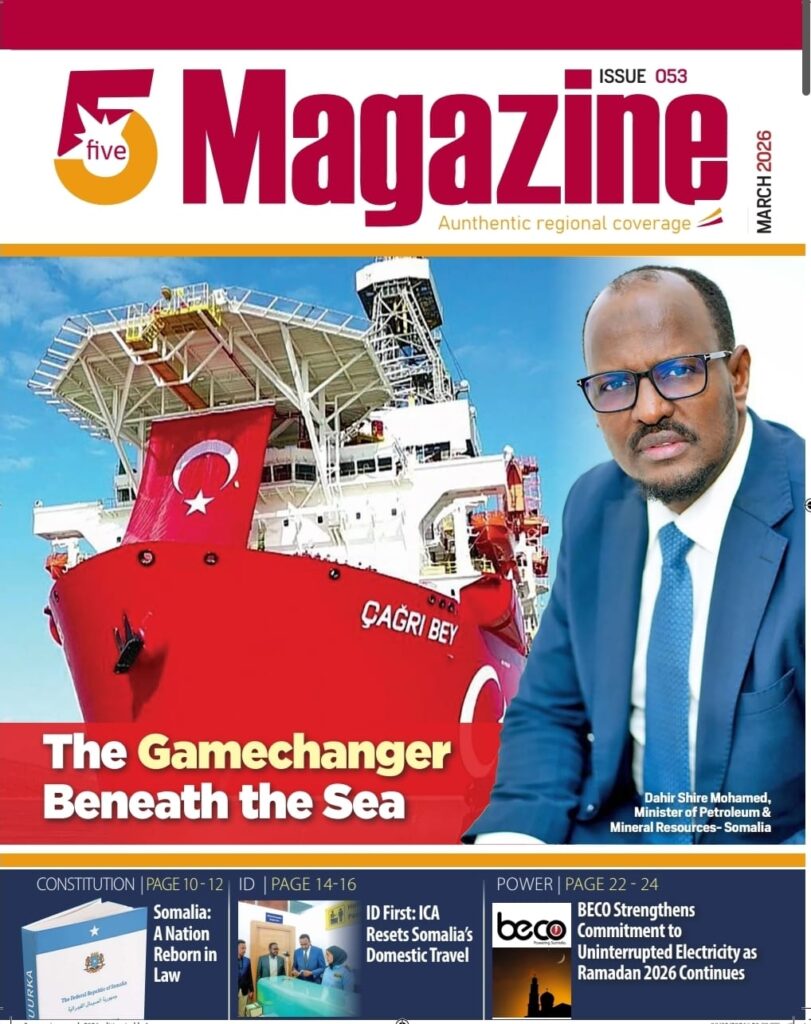
In a wide-ranging interview with Hanoolaato Digital Media, Somalia’s Minister of Petroleum and Mineral Resources, Dahir Shire Mohamed, laid out what he believes could become the most transformative economic breakthrough in the country’s modern history.
After decades of seismic surveys, legislative reforms, stalled ambitions, and renewed political commitment, Somalia is now preparing to drill its first modern offshore well, a moment the Minister describes as potentially a “Gamechanger.”
From Rumor to Reality
For years, Somalia’s oil story has oscillated between hope and skepticism. Many have questioned whether the renewed momentum around petroleum exploration is genuine or merely political rhetoric.
“The fact that oil development has materialized is true, and we thank Allah for reaching this stage,” the Minister said, crediting the leadership of President Hassan Sheikh Mohamud and Prime Minister Hamza Abdi Barre for what he called bold and determined action.
According to the Minister, groundwork began during President Hassan Sheikh’s first term, but momentum accelerated significantly after his return to office in 2022. It was during this period that Somalia conducted its first modern 3D seismic assessment, a technological leap forward in evaluating offshore potential.
“This level of progress required courage,” he said, noting that political will had to align with technical capacity.
A 75-Year Journey
Somalia’s petroleum exploration dates back to 1948. After independence in 1960, more than 64 wells were explored across the country, with 24 confirming the presence of oil and gas. However, the collapse of the state in 1991 halted meaningful development.
Reforms resumed gradually. A Petroleum Law was introduced in 2008 and later amended in 2014 and 2016. Offshore 2D seismic surveys were conducted across three basins, Qoryooley, Juba, and Hobyo, covering approximately 140,000 square kilometers of maritime territory.
Those surveys yielded encouraging data. Between 2018 and 2020, further amendments strengthened the legal framework, including the Baidoa resource-sharing agreement and the establishment of the Somali Petroleum Authority.
From 2022 to 2025, Somalia signed 19 Production Sharing Agreements, 13 offshore and 6 onshore. Then came the most decisive step yet: advanced 3D seismic studies over three offshore blocks awarded to Türkiye.
The results paved the way for the arrival of the drilling vessel Çağrı Bey, which is preparing to drill the first offshore well, named Curad-1, by the President.
Why Now?
For decades, exploration was discussed but never fully executed. So, what changed?
“If you are determined to achieve something, and Allah brings you a partner who is more capable, more resourced, and sincere, then success becomes possible,” the Minister explained.
He credited Türkiye’s willingness to assume the risks associated with Somalia’s energy sector. The project is being carried out by the Turkish Petroleum Corporation, backed directly by the Turkish government, including naval and logistical support.
“What is happening now is not based on rented equipment,” he said. “The vessel is among the most advanced in the world.”
The Minister emphasized that progress has been unusually rapid by international standards, moving from agreements to 2D surveys, to 3D assessments, and now to drilling within a relatively short timeframe.
Managing Risk and National Perception
Oil exploration in a country long associated with insecurity inevitably raises questions. When asked Could drilling create geopolitical tensions? Could it introduce new risks? He said, “Every major undertaking carries risk,” the Minister acknowledged. “But the government has taken all necessary precautions.”
He also addressed the role of public discourse, expressing concern about destructive criticism on social media platforms.
“Constructive criticism is healthy. But destructive criticism that undermines national security harms us,” he said. “Our voices travel far online. Let them advocate for oil development, for security, and for state-building.”
Sovereignty and Partnership
Some critics have suggested that Türkiye’s deepening involvement could signal neo-colonial ambitions. The Minister dismissed such claims firmly. “Somalia is a sovereign and independent nation,” he said. “To suggest that Somalia can be colonized today is misguided.”
He pointed to Türkiye’s diplomatic engagement in Somalia since 2011, when then-Prime Minister Recep Tayyip Erdoğan visited Mogadishu at a time when few international leaders dared to do so. That visit, he argued, shifted global attention toward Somalia’s recovery.
“Back then, Türkiye helped the world see Somalia’s humanitarian crisis. Today, it is helping the world see Somalia’s resources.”
The “Gamechanger” Moment
At the heart of the Minister’s vision is the belief that commercial oil production could fundamentally alter Somalia’s economic trajectory.
“If we successfully produce oil, I believe it will be a game-changer. The country will enter a new chapter, God willing,” he said.
He cautioned, however, that drilling does not equal instant wealth. The Curad-1 well will require between 90 and 180 days of drilling. Samples must be extracted, tested in laboratories, quantified, and assessed for commercial viability.
“The most important step is verifying whether it is commercially viable,” he explained.
If confirmed, the ripple effects could be substantial: industrial expansion, foreign investment, job creation, and energy sector growth. “One well does not mean Somalia will sit on top of it and become rich overnight,” he noted. “It opens the economy. It brings factories. It creates employment.”
Importantly, Somali engineers who have undergone specialized training will be part of the drilling crew, a sign that local capacity is being built alongside foreign expertise.
A Message to the Youth
Having worked for over three decades in business and international humanitarian sectors before entering government, the Minister says his optimism has only grown since taking office. “I have always believed Somalia can be rebuilt,” he said. “Now that I sit at the decision-making table, my optimism is even stronger.”
His final message was directed at Somali youth. “The future is prepared for you,” he said. “Let what you spread be hope. Support state-building. A dignified government is honorable; statelessness is not.”
He concluded by echoing President Hassan Sheikh Mohamud’s recurring message: “The good days are coming.”