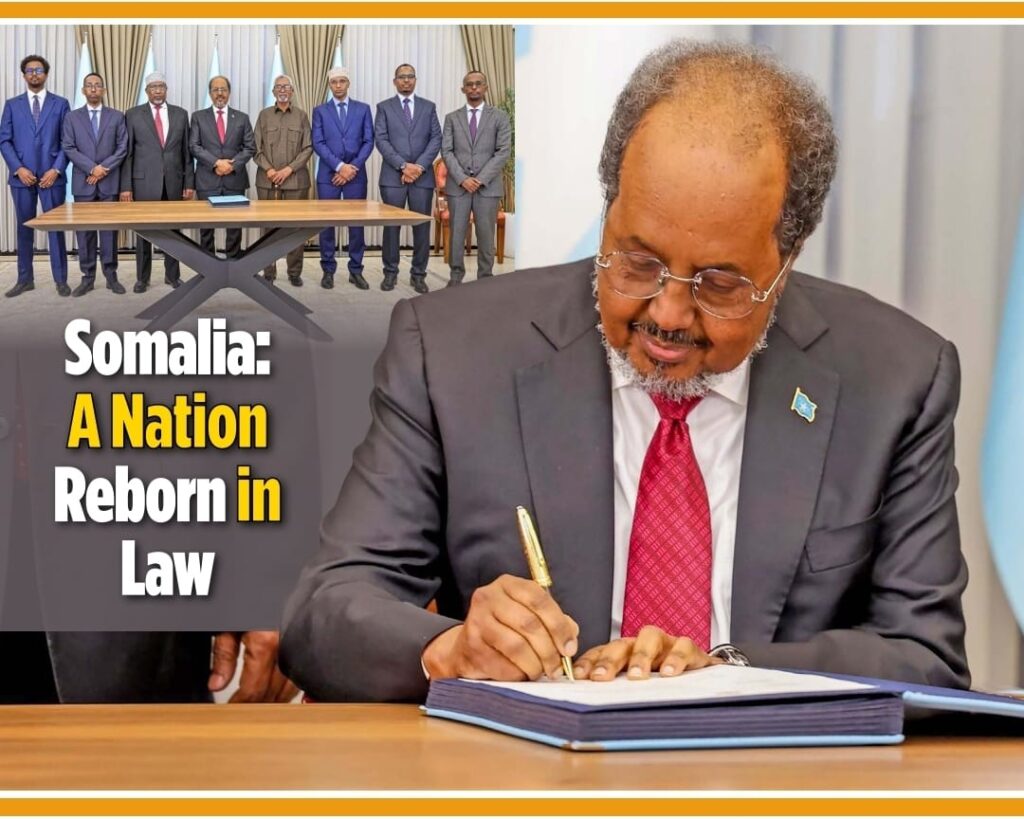
On Sunday, March 8, 2026, President Hassan Sheikh Mohamud formally signed Somalia’s newly approved Constitution, completing the final legal step required for its enactment. The signature follows the overwhelming approval of the document by both Houses of the Federal Parliament on March 4, marking the culmination of a lengthy constitutional review process.
The signing ceremony took place at the Presidential Palace in Mogadishu and was attended by the leadership of both chambers of Parliament. During the event, President Mohamud described the moment as the completion of a critical phase in Somalia’s constitutional transformation.
“Somalia’s Federal Parliament has finalized the constitutional review. From today onward, our responsibility is to implement it and ensure that the Somali people can fully enjoy the rights and fulfill the duties outlined in it,” the President stated.
He emphasized that the Constitution represents a national social contract, one that provides the foundation for transparent governance, stronger institutions, and lasting political stability.
“This document is a social contract, and I hope it will lead Somalia toward peace, stability, and accountable, effective governance,” he added.
The presidential signature represents the final formal step toward the Constitution’s enactment, although additional procedures and institutional arrangements are expected as the country begins implementing its provisions.
Parliamentary Approval Marks Historic Turning Point
On Wednesday, March 4, 2026, Somalia marked one of the most consequential milestones in its modern political history. In a joint session of the two Houses of the Federal Parliament, lawmakers voted overwhelmingly to approve the official Constitution of the Federal Republic of Somalia, formally concluding a prolonged transitional era and ushering in a new constitutional order.
According to Speaker Sheikh Aden Mohamed Nur, known as Aden Madobe, 186 members of the House of the People and 37 Senators from the Upper House voted in favour of the Constitution by majority vote. The decision represents not merely a legislative act, but a historic turning point for a nation that has spent decades striving to rebuild its institutions, restore stability, and reclaim its rightful place in regional and global affairs.
Promise Made, Promise Fulfilled by President Hassan Sheikh
At the canter of this achievement stands President Hassan Sheikh Mohamud, who is currently serving his second four-year term in office. The passage of the Constitution fulfills one of his key campaign promises and cements his legacy as a leader determined to move Somalia from provisional governance to a fully-fledged constitutional state. It is a bold and far-reaching reform, and one that underscores his long-standing commitment to institution-building, accountability, and democratic consolidation.
In a national address delivered shortly after the parliamentary vote, President Mohamud expressed deep satisfaction and described the moment in unmistakably historic terms.
“For all Somalis, today is a historic day marked by the completion of our national Constitution and the formal conclusion of the long transitional period that has stretched on for many years,” he declared.
He added: “Today is a day that will be remembered as the achievement of a long-awaited national victory, one that has lifted us out of provisional governance and set us firmly on the path toward a stable system of government founded on a strong legal framework.”
From Provisional Framework to Full Constitutional Legitimacy
For more than 14 years, Somalia operated under a provisional constitutional framework. While it served as a temporary guide, it also created legal ambiguities and structural constraints that hindered political clarity, security coordination, economic development, and international engagement. The newly approved Constitution removes those constraints and provides a complete legal foundation upon which state institutions can operate with legitimacy and predictability.
President Mohamud emphasized that Somalia’s constitutional journey has been long and complex. “Since independence in 1960, Somalia has passed through different constitutional and governmental phases,” he noted. Yet, he stressed that the importance of this development goes beyond the mere ratification of a document.
“The value of this day for the Somali people lies not only in the ratification of the Constitution, but in the fact that Somalia has now formally moved beyond the transitional phase and stepped into a fully-fledged constitutional state with complete legal legitimacy,” he said.
This transition from provisional to permanent constitutional governance is widely regarded as one of the most important political achievements in Somalia’s post-conflict recovery. It provides clarity in the distribution of power, reinforces the rule of law, and signals to citizens and international partners alike that Somalia is committed to stability and democratic norms.
Justice and Constitutional Affairs Minister Hassan Maalim hailed the development as a landmark in the country’s journey toward national unity and good governance.
“The Constitution did not come easily. It has taken time, resources, and unwavering commitment from all stakeholders to craft a document that reflects the aspirations of the Somali people. Today, we lay the foundation for a just, secure, and prosperous Somalia,” Minister Maalim stated.
His remarks reflect the collaborative effort behind the constitutional process. The review, amendment, and finalization of the Constitution required extensive consultations, political negotiation, and institutional coordination. President Mohamud personally oversaw consultations across the country, dedicating political capital and resources to ensure that the final document reflected national aspirations rather than narrow interests.
Separation of Powers and Judicial Independence
One of the most significant features of the new Constitution is its firm separation of powers. By clearly defining the roles of the Executive, Legislature, and Judiciary, it establishes oversight mechanisms designed to prevent abuse of office, enhance transparency, and safeguard democratic governance. A strengthened and independent judiciary is expected to adjudicate disputes impartially and restore public trust in state institutions.
The governance framework also clarifies Somalia’s federal structure, delineating the distribution of authority between the Federal Government in Mogadishu and regional administrations. This is anticipated to reduce jurisdictional conflicts, streamline security coordination, and improve service delivery throughout the country.
Clear Rules for Leadership, Integrity, and Accountability
Among its most notable provisions are clear rules governing leadership and accountability. The President of Somalia is elected by Parliament, while Members of Parliament are elected directly by the people. The Prime Minister is appointed by the President but may be removed by Parliament, reinforcing parliamentary oversight.
Term limits have been constitutionally entrenched: no individual may serve as President for more than two terms. The minimum age to run for President is set at 40 years, with no upper age limit. The minimum age to become a Member of Parliament is 25, while the minimum age to serve as a minister is 30.
The Constitution also establishes strict integrity requirements for top officials. The President, Prime Minister, the two Speakers of Parliament, and the Chief Justice of the Supreme Court are prohibited from holding dual citizenship. If elected or appointed, they must renounce any foreign nationality. They are also barred from having a foreign spouse. Furthermore, these officials are required to declare their movable and immovable assets to the Auditor General upon assuming office.
These measures send a powerful message about transparency, loyalty, and public accountability. By codifying such standards, the Constitution aims to strengthen public confidence and align Somalia’s governance practices with international expectations.
In addition, if a Member of Parliament is appointed as a minister, they automatically lose their parliamentary seat, and their replacement is selected according to the electoral law. This provision reinforces the separation between legislative and executive responsibilities and prevents conflicts of interest.
The official term length of the Federal Government is set at five years, providing predictability in governance cycles. The Constitution also clarifies civic benchmarks, setting the age of religious maturity at 15 years and the age of legal responsibility and civic accountability at 18 years.
A New Governance Model for Mogadishu
One of the most innovative aspects of the Constitution concerns the status of Mogadishu. The capital is now designated as a Capital Region. Residents will elect a local council, which will, in turn, elect district commissioners and a Capital Council. The Capital Council will elect the Mayor of Mogadishu. While the Mayor will oversee municipal administration and local governance, the Federal Government will appoint a senior official responsible for security and political oversight in the capital.
This model balances decentralization with national oversight, creating a governance structure that is both locally accountable and nationally coherent. It is widely seen as a best-practice approach that enhances urban governance while safeguarding national security interests.
Human Rights, Federal Clarity, and National Unity
The Constitution also expands and reinforces human rights protections. It safeguards civil liberties, affirms equality before the law, and addresses longstanding grievances. These provisions are expected to support reconciliation efforts and foster inclusive development, essential components of long-term peace.
Policy experts have described the approval as transformative. The establishment of a coherent constitutional order is widely viewed as the foundation for unlocking Somalia’s vast economic and social potential. With a clear legal framework in place, the country is better positioned to attract investment, strengthen public institutions, and engage confidently in international diplomacy.
A Defining Legacy for President Hassan Sheikh Mohamud
President Mohamud’s leadership in this process is especially significant given that constitutional reform was one of his central campaign promises. Now in his second term, he has demonstrated consistency and resolve in delivering on that pledge. By prioritizing constitutional completion, he has addressed a structural challenge that has lingered for more than a decade.
In his national address, he reflected on the broader implications of the moment: “Today, the long journey our nation has undertaken has reached its intended destination, the establishment of a complete constitutional foundation that guides the work of our institutions and empowers the Somali people to shape the political direction of their country.”
He further explained that the new Constitution will provide greater predictability and clarity about Somalia’s future, grounded in constitutional legitimacy owned by both the state and its citizens.
This is not simply a legal reform; it is a statement of national confidence. It signals that Somalia has moved beyond a transitional mindset and embraced the responsibilities of a stable constitutional democracy. It provides a durable framework for governance, strengthens checks and balances, and codifies democratic norms.
Above all, the approval of the Constitution on March 4, 2026, stands as a historic and bold achievement, one that will shape Somalia’s trajectory for generations to come. It represents the culmination of years of effort and the realization of a campaign promise that many considered ambitious but necessary.
For President Hassan Sheikh Mohamud, it is a defining accomplishment of his presidency and a testament to strategic foresight and political will. For Somalia, it marks the dawn of a new constitutional era, one rooted in legality, accountability, unity, and hope.