By Fuad Haji Abdiweli,
In a vibrant ceremony celebrating Somali digital creativity, the “Daaci 2026” program wrapped up its first season in Mogadishu on Monday, March 30, recognizing young content creators who used their platforms to spread positive social and religious messages during the holy month of Ramadan.
The initiative was launched by Nasiye, a startup founded by young entrepreneurs that provides IPTV services, with support from telecommunications giants Hormuud Telecom and Wafi. The program sought to reshape Somalia’s online space by encouraging influencers to move away from harmful or controversial content and instead focus on themes of faith, ethics, and national pride.
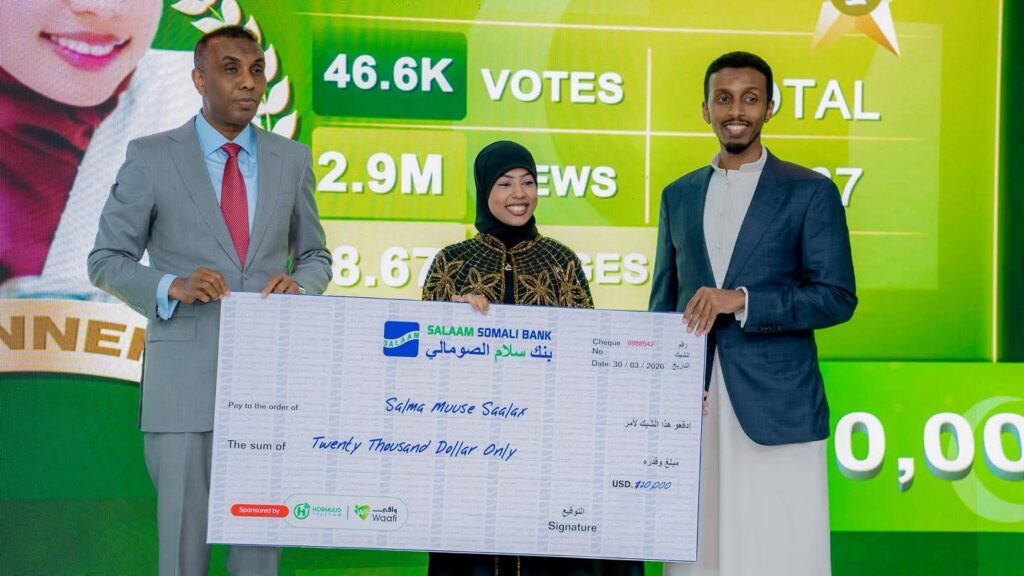
Out of more than 4,000 applicants, 120 contestants were selected to participate in the competition. The program generated thousands of videos that reached millions of viewers across social media platforms, particularly TikTok. At the closing ceremony, the grand prize of $20,000was awarded to Salma in recognition of their outstanding impact.
One of the most striking aspects of the program was the scale of public engagement it generated during Ramadan. According to program organizers, contestants produced 1,579 videos, many of which quickly circulated across social media platforms and messaging groups, turning Daaci2026 into one of the most widely followed digital initiatives in Somalia during the holy month.
Public participation also played a major role in determining the competition’s outcome. Through the Nasiye app, more than 381,000 users cast votes for their favorite creators, demonstrating how strongly audiences responded to content that combined entertainment with meaningful social and religious messages.
The reach of the program was equally remarkable. Organizers reported that videos created under the Daaci initiative accumulated over 82 million views, highlighting the growing influence of Somali digital creators and the potential of social media as a platform for positive engagement.
Throughout the competition, participants were given weekly themes that addressed important social and moral issues. These topics were designed to encourage contestants to produce videos that promoted awareness, ethical behavior, and community responsibility. In this way, Daaci2026 functioned not only as a competition but also as a digital awareness campaign aimed at guiding online audiences toward constructive conversations.
The program was built around the central principle of “Faafinta Kheyrka” — spreading goodness. Organizers emphasized that participants were not simply competing for prizes, but also fulfilling a social and moral responsibility by sharing messages that could inspire positive change within their communities.
In addition to the $20,000 grand prize, the competition featured several other rewards. The second-place winner received a fully funded Umrah pilgrimage package, while third- and fourth-place winners were awarded the latest iPhone models, further motivating participants to produce high-quality and impactful content throughout the program.
Beyond the competition itself, the program also created moments of community celebration during Ramadan. Organizers noted that more than 50 children were included in special Eid activities connected to the program, reflecting Daaci’s broader effort to combine digital engagement with real-world community initiatives.
The opening speech at the Daaci 2026 Awards Ceremony was delivered by the General Manager of Nasiye, Eng. Burhan Omar Sheikh.
“The Daaci 2026 program was launched during the month of Ramadan by engaging famous youth on TikTok, challenging them to compete in promoting goodness and virtue,” he said. “The results have been remarkable. Nasiye is a company founded by young people that provides IPTV services, intended to reach Somalis everywhere with positive stories from our country. We want to replace the negative narratives often associated with Somalis, such as drought and piracy, with stories of goodness and talent.”
The idea for the program dates back to 2019 and was inspired by the rapid rise of Somali TikTok personalities. Abdalla Sheikh Ahmednuur, Hormuud’s Chief Financial Officer and the driving force behind the Daaci initiative, explained that while internet access has expanded significantly over the past decade, it has also been accompanied by the spread of content “contrary to Islamic culture and good ethics.”
“As you are aware, internet usage has surged over the last 10 to 15 years, leading to a rise in Somali youth becoming content creators. Alongside positive content, however, there has been an increase in videos that contradict Islamic culture and good ethics,” stated Abdalla.
“While the harm of such content was widely discussed, no solution had been found. Deeply concerned by this, I conceived the idea for ‘Daaci’ in 2019 after meeting Daaci Abubakar and Daaci Omar in Mogadishu, two young men already using their platforms to share positive messages. The goal is to cultivate a generation of Somali youth who use social media to spread goodness, effectively putting an end to content that undermines our faith and culture.”
Deputy Minister of Information Abdirahman Al-Adaala also welcomed the change in digital culture, noting that parents who once worried about the online figures influencing their children now have a “virtuous” alternative to look up to.
The event was officiated by Prime Minister Hamza Abdi Barre, who emphasized that every citizen has a role to play in strengthening moral values in society. In a surprise announcement, he also pledged that the Somali government would provide Hajj visas for the winners of the next edition of the program, Daaci 2027.
“Every individual, whether you are a merchant, journalist, politician, or cleric, can draw closer to God through their professional work while building a virtuous society,” the Prime Minister told the gathering.
The Minister of Family Affairs and Human Rights Development, Khadija AlMakhzoumi, congratulated the organizers of the program and praised its success. She commended the competition overall and especially recognized the women who emerged among the top winners, noting that in many competitions held across the country, women frequently secure leading positions. According to the minister, this reflects the determination, resilience, and hard work of Somali women.
In the Daaci program, the top three positions were all won by female contestants.
“In every competition where women succeed, or when women consistently achieve the highest positions in academic examinations, it stands as testimony to the dedication and perseverance of Somali women, who today are preparing themselves for leadership in all fields. As a government, we encourage and support this progress. The truth is that in many areas we are even outperforming men, and if we unite, we will achieve even greater success, Insha Allah,” she said.
The success of the Daaci program signals a growing recognition among private companies and the Somali government that social media can serve not only as a communication tool but also as an important platform for cultural influence and moral development.