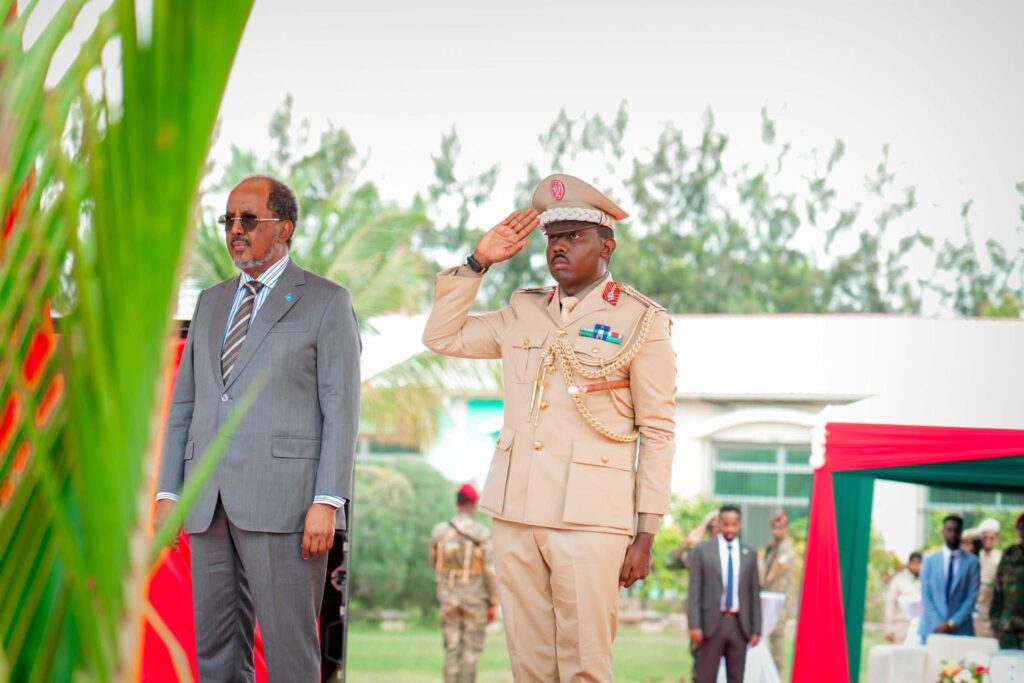
The 66th anniversary of the Somali National Army (SNA) was marked with ceremony and symbolism in Mogadishu on Sunday, bringing together the country’s top leadership and military command.
President Hassan Sheikh Mohamud, alongside Defence Minister Ahmed Moallim Fiqi and Army Commander Brigadier General Ibrahim Mohamed Mahmoud, presided over the event.
A military parade featuring armored vehicles, aircraft, and traditional displays underscored the army’s evolving capabilities. The day also saw the launch of an Orphans Care Agency to support families of fallen soldiers in an acknowledgment of sacrifice woven into the institution’s history.
Anniversaries of national armies are often steeped in pageantry, but Somalia’s carries deeper meaning. For a country that has endured decades of state fragility, the SNA represents more than force, it symbolizes sovereignty, unity, and the slow rebuilding of national institutions. The Mogadishu celebrations were therefore not merely ceremonial; they were a signal that Somalia is steadily reclaiming control over its security narrative.
Why a strong army matters
A capable and disciplined military is the backbone of any stable state. In Somalia, this truth is magnified by years of insurgency and external threats. The SNA plays a central role in securing territory, supporting governance, and protecting civilians from extremist groups. Without a strong army, political gains remain fragile, and economic recovery risks stagnation. Stability in Somalia is inseparable from the strength of its armed forces.
A calmer security landscape
Encouragingly, Somalia has experienced relative calm over the past year, with fewer large-scale terror attacks reported compared to previous periods. While threats persist, sustained military operations and improved coordination with regional partners have weakened militant networks. This relative peace is not accidental. Rather, it reflects growing operational capacity within the SNA and a more coherent national security strategy.
Regional stakes in Somalia’s stability
Somalia’s security is not confined within its borders. Instability in the country has historically spilled over into the Horn of Africa, affecting neighbours through terrorism, refugee flows, and disrupted trade. A stronger Somali National Army contributes directly to regional stability, easing the burden on international peacekeeping forces and allowing countries like Kenya and Ethiopia to focus on development rather than containment. In this sense, the SNA is not just a national institution; it is a regional stabilizer.
Leadership, sacrifice, and the road ahead
President Mohamud captured this broader vision, stating, “Our armed forces are the shield of our nation and the foundation upon which Somalia’s peaceful and prosperous future will be built.”
His remarks reflect a government keen to consolidate recent gains. Army Commander Mahmoud echoed this resolve, noting, “The Somali National Army is the backbone of the country’s defense, and our victories against terrorist groups show what unity and determination can achieve.”
The establishment of the Orphans Care Agency adds a human dimension to this narrative, reminding the nation that progress has come at a cost. Supporting the families of fallen soldiers is both a moral duty and a reinforcement of institutional integrity. The Head of State and the top military officials also officially opened the 250km road between Baydao and Mogadishu, which will enable seamless movement and people and services between the two regions.