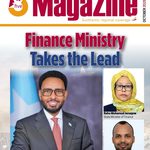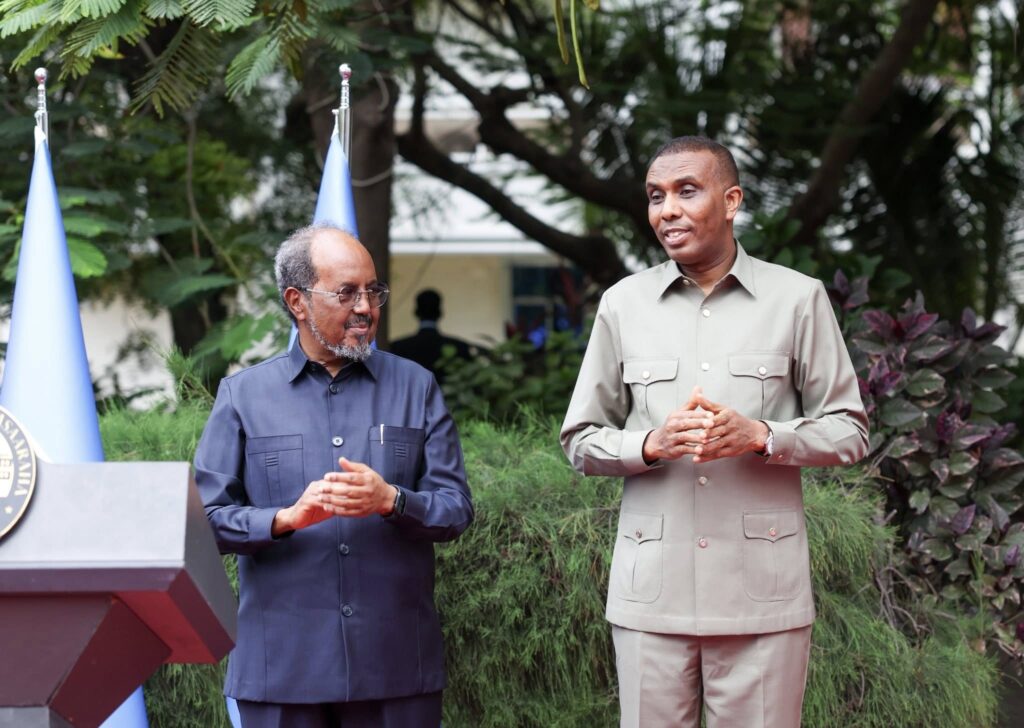
On August 23, 2025, the Somali capital of Mogadishu played host to a milestone moment in governance. President Hassan Sheikh Mohamud officially closed the DanQaran Government’s week-long self-evaluation program, a bold initiative spearheaded by Prime Minister Hamza Abdi Barre. This unprecedented exercise was designed to assess promises kept, challenges faced, and the future direction of the administration.
For seven days, government ministries opened their books before the Somali people. They showcased achievements, acknowledged setbacks, and outlined future priorities. President Mohamud praised the process, highlighting the courage of ministers who laid bare both progress and pitfalls.
“This program strengthens transparency, accountability, and the trust our citizens place in their government,” the President remarked at the closing ceremony.
In a political landscape often criticized for opacity, the President positioned DanQaran’s approach as a turning point. He noted that the gains of the past three years formed a solid foundation for the future, but warned that ambition must now be matched with redoubled effort to realize Somalia’s long-term national vision.
At the same event, Prime Minister Barre underscored that accountability would not be a one-off spectacle. Instead, it would become a recurring culture of governance. “Ministries must honor the commitments they made to the Somali people,” he urged. “This exercise will continue, only in a more rigorous, permanent form.”
Tracing the Accountability Journey
The program was formally launched on August 17, when the Prime Minister introduced the process of reviewing the DanQaran government’s blueprint. The agenda was simple but ambitious: revisit what had been achieved in three years of governance, examine unkept promises, and chart the way forward.
Hamza reminded the citizens of his earlier pledge to champion good governance, pointing to tangible progress across sectors during his administration’s first three years. He framed the accountability week as a national check-in, a way to measure if the government was truly delivering on its social contract.
“We want to sit down with the Somali people to weigh what has been accomplished, what challenges remain, and what must be done next. We have completed three years; we are in the fourth. I am convinced this country has made real strides in every sector,” Hamza Barre said
Ministries Under Review
Beginning with the Economic Development Cluster, ministries showcased key results:
- Growth in domestic revenue collection and the roll-out of a modern financial management system.
- Trade facilitation measures and renewed push for industrialization.
- Steps toward attracting international investment.
- Expanding agricultural productivity and modern irrigation.
- Safeguarding marine resources.
- Infrastructure renewal, from roads and ports to aviation.
- Employment creation programs targeting youth and vulnerable communities.
The Prime Minister grilled ministers on their national action plans, reminding them that accountability is not just about numbers but about honoring commitments in ways visible to ordinary citizens.
The Social Services and Governance Cluster followed, presenting gains in healthcare and education, human rights protections, family welfare, cultural preservation, youth empowerment, environmental protection, and community awareness campaigns driven by media and civil society.
The Security, Defense, and Justice Cluster came under scrutiny next. Here, ministries showcased reforms in federalism, reconciliation, international diplomacy, and internal security. Efforts included strengthening the armed forces, liberating and stabilizing previously insecure territories, reforming the judiciary, and reviewing the national constitution.
Prime Minister Barre emphasized that this exercise was not a public relations event but a structural shift in governance. The accountability framework would become a permanent feature of Somalia’s political landscape under DanQaran.
“Transparency and accountability will define our administration. Every ministry will be measured against its promises, and the Somali people will be the ultimate judges of our performance.”
The administration has already institutionalized this ethos with the launch of the Coordination and Delivery Unit (CDU), directly under the Prime Minister’s Office. The CDU is tasked with monitoring implementation of government pledges, accelerating development projects, and ensuring cross-ministerial coordination.
Presidential Backing
At the close of accountability week, President Mohamud reaffirmed his support for Prime Minister Hamza’s approach. He inaugurated a new Government Performance Monitoring Department, located within the PM’s Office, which will track whether ministries follow through on commitments.
The President described the DanQaran government’s progress over the past year as “visible and impactful,” citing improved public service delivery and steps toward Somalia’s national aspirations.
A Shift in Somali Governance
In its three years, the DanQaran administration has already laid claim to achievements in economic revival, enhanced security, infrastructure development, and the decentralization of government services. By making accountability a regular practice, the government hopes to build capacity and confidence, at home and abroad.
The accountability week symbolized a government willing to show its report card, even when the grades are mixed. It marked an attempt to recast the relationship between citizens and the state: not one of distant promises, but of measurable performance.
As President Mohamud reminded at the closing ceremony, progress so far is only a starting point: “The successes of the past three years are the bedrock of Somalia’s future, but we must double our efforts to reach the nation’s long-term vision.”
In the East Africa region, where accountability is often elusive, Somalia’s experiment with accountabilitymay stand as one of the country’s boldest democratic innovations yet.