By Fuad Haji Abdiweli
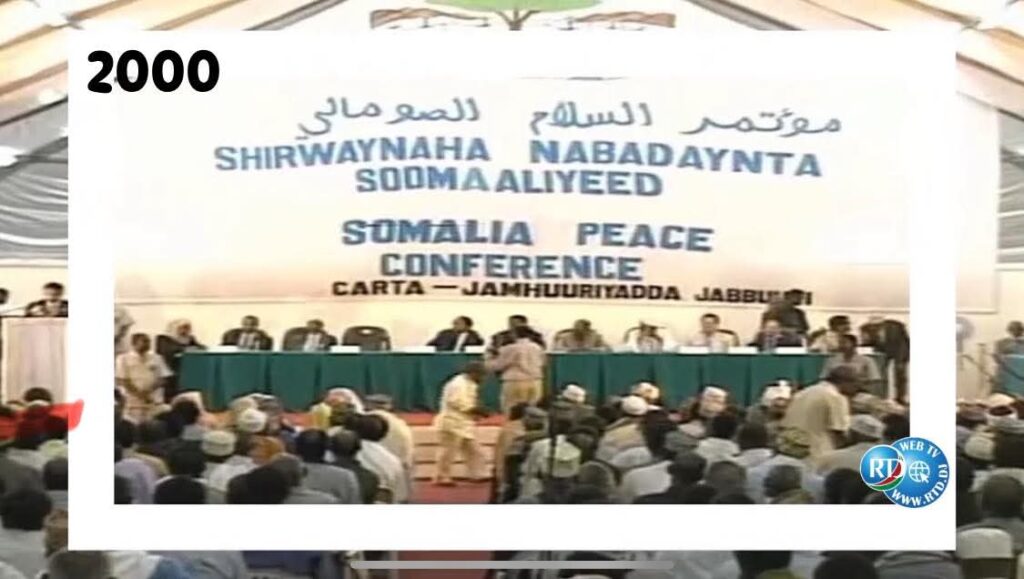
Twenty-five years ago, in the small Djiboutian town of Arta, Somalis from across the political and clan divides gathered with a sense of weary hope. It was not the first peace conference Somalia had seen; many had come and failed before, but Arta felt different. For the first time, it was not just warlords and faction leaders sitting at the table. Elders, religious scholars, women, and members of the diaspora were all given a voice. What began as a modest effort in a regional neighbor’s quiet town turned into a landmark moment that reshaped Somalia’s political future and gave birth to the Transitional National Government.
The pre-Arta conferences
1991 First Attempts at Reconciliation
After the overthrow of Mohamed Siad Barre in 1991, the first two reconciliation conferences aimed at re-establishing a Somali state took place in Djibouti in June and July 1991.
Six organizations participated in these meetings. The meeting endorsed Ali Mahdi Mohamed as the president of Somalia, but this decision was immediately opposed and boycotted by General Mohamed Farah Aydiid, and a bloody civil war immediately followed in Mogadishu and southern Somalia.
The 1993 National Reconciliation Conference
In March 1993, fifty-five parties involved in the Somali civil war signed two agreements in Addis Ababa for reconciliation and disarmament: one was an informal meeting to prepare for national reconciliation, and the other was the major agreement signed in Addis Ababa in 1993, which was the outcome of a national reconciliation conference. Unfortunately, the fighting did not stop, and the agreement fell apart.
National Security Council 1997
Between November 1996 and January 1997, a national reconciliation conference was held in Sodere, Ethiopia. The conference established a 41-member National Salvation Council (NSC) tasked with organizing a transitional government, but the conference was boycotted by Hussein Farah Aideed (who was then leading his father’s group after the death of Gen. Aideed) and the Somaliland administration.
A similar conference held in Sana’a, Yemen, was attended by all parties involved in the crisis in Somalia, and the points that emerged from that conference were rejected by those who did not attend the conference.
Cairo Peace Conference 1997/ Cairo Declaration
A fourth reconciliation conference was held in Cairo, Egypt, in December 1997, and the agreement that emerged from this conference was signed by 28 members, including Ali Mahdi and Hussein Farah Aideed.
The “Cairo Declaration” established a 13-member Council that included presidents, prime ministers, and parliamentarians, but there was no consensus on establishing a single national president for the country.
What made Arta different?
The Arta Conference of 2000 stood out from earlier Somali peace initiatives because it broke with the old formula that had centered negotiations around faction leaders and militia commanders. Instead, it prioritized inclusivity and Somali ownership. Ordinary citizens, civil society groups, traditional elders, women, and the diaspora were invited to participate, marking a sharp departure from the warlord-dominated talks of the 1990s.
Dr. Ibrahim Dazuqi, a seasoned Somali scholar and a delegate of the Arta conference, believes that this was one of the foundations that made Arta work. However, when asked whether warlords were excluded from the conference, he replied, “No one was barred. Some simply chose not to come. Had they come, they would have been welcomed like everyone else.”
On whether Arta’s success might have prevented later reconciliation talks in Mbagathi, Dr. Ibrahim said, “Without Arta, there would have been no Mbagathi. Arta created the foundation and legitimacy that made Mbagathi possible.”
He believes that even if warlords had attended Arta, they wouldn’t have derailed it: “The real power lay with the elders. The warlords could either join in or stay out.”
“The atmosphere in Arta was historic, for the first time, intellectuals, elders, and civil society leaders met freely without warlord interference. The sense of brotherhood and reconciliation was powerful, and Djibouti’s hospitality only strengthened it,” said Abdikarim Hussein Guled, former Galmudug president.
Unlike previous conferences sponsored and tightly controlled by foreign powers, Arta was facilitated by Djibouti under President Ismail Omar Guelleh’s leadership, but it allowed Somalis to lead their own discussions. According to numerous sources who attended the conference, the atmosphere was less about dividing power among armed groups and more about rebuilding a sense of national identity and shared purpose.
Dr. Ibrahim Dazuqi believes that President Ismail Guelleh and the Djibouti people were the biggest factors that made Arta a success. He described the atmosphere in Arta as deeply Somali and unifying. “The Djiboutians were incredible,” he said. “Beyond the hospitality everyone mentions, they organized patriotic songs, plays, and cultural events inside the tents, all urging people to abandon clan divisions and embrace unity. Once there, no one opposed forming a government; the debates were only about the structure and process. President Guelleh, may Allah reward him, was a huge factor in Arta’s success.”
Former Galmudug president Abdikarim Hussein Guled said, “Several factors made Arta a success: Djibouti’s deep understanding of Somali culture, its genuine solidarity, the unifying power of Somali poetry and music performed by artists from both nations, and the active role of Djibouti and Somali media.”
Another factor in its success was the timing. After nearly a decade of conflict, many Somalis were exhausted by war and ready for change. The inclusion of the 4.5 clan power-sharing formula, giving space to major clans and minorities alike, also provided a pragmatic, if imperfect, political balance. All these elements combined to make Arta not just another peace meeting, but the first genuine attempt to rebuild a Somali state from the voices of its people rather than the ambitions of its warlords.
“I coined a phrase that guided us: ‘This is about a solution, not entitlement.’ Meaning, no one would get everything they deserved, but everyone would get peace,” said Abdikarim Hussein Guled.
Post-Arta governments
Abdiqasim Salad Hassan (2000–2004)
After the Arta Conference, Abdiqasim Salad Hassan became the first president of Somalia’s Transitional National Government (TNG). His biggest achievement was reestablishing a central government after nearly a decade of statelessness. Under his leadership, Somalia regained international recognition and began rebuilding basic political institutions, even though his control was limited mostly to Mogadishu. Abdiqasim’s administration marked the first hopeful step toward national governance since the collapse of the Siad Barre regime in 1991.
Abdullahi Yusuf Ahmed (2004–2008)
Abdullahi Yusuf Ahmed’s presidency was defined by security and federal formation. He helped create the Transitional Federal Government (TFG), which replaced the TNG, and successfully brought it from exile in Kenya back to Somalia. His government ousted the Islamic Courts Union (ICU) from Mogadishu in 2006, restoring official government presence in the capital for the first time in years.
Sheikh Sharif Sheikh Ahmed (2009–2012)
Sheikh Sharif Sheikh Ahmed was a unifying national figure. His presidency is best remembered for leading the fight against Al-Shabaab and rebuilding government institutions during a period of transition. With support from AMISOM forces, he pushed back militant control and began establishing key state structures such as ministries, a judiciary, and security agencies. Sheikh Sharif also guided the drafting of frameworks that led to Somalia’s transition from a provisional to a more permanent government structure.
Hassan Sheikh Mohamud (First Term: 2012–2017)
Hassan Sheikh Mohamud became the first president elected inside Somalia in over two decades, symbolizing the country’s return to domestic political stability. His main achievement was launching “Vision 2016”, a reform agenda that prioritized federalism, institution-building, and reconciliation. Under his leadership, several new federal member states were established, including Galmudug and Hirshabelle, strengthening Somalia’s federal structure. He also improved relations with international partners and advanced Somalia’s reintegration into global institutions.
Mohamed Abdullahi “Farmaajo” Mohamed (2017–2022)
Farmaajo’s presidency was marked by a strong nationalist and anti-corruption agenda. His biggest accomplishment was strengthening the Somali National Army (SNA) and promoting sovereignty by reducing dependence on foreign troops. His administration pursued reforms in defense and governance, aiming to make Somalia more self-reliant. Farmaajo also emphasized nationalism and sought to centralize authority to ensure strong, unified leadership, though this often brought political tensions with regional states.
Hassan Sheikh Mohamud (Second Term: 2022–present)
Returning to office in 2022, Hassan Sheikh Mohamud’s second term has focused on reconciliation and the total war against Al-Shabaab. His government has coordinated with local communities to liberate large territories from militant control, marking one of the most successful counterterrorism campaigns in recent years. Additionally, under his leadership, Somalia attained debt relief, secured a non-permanent seat at the UN Security Council, and joined the EAC.