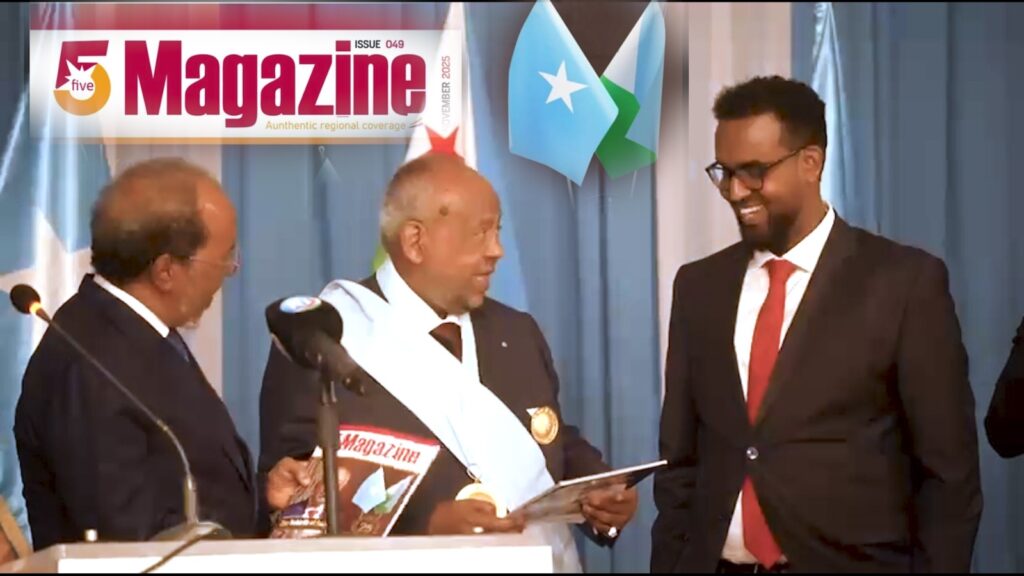
“Somalis, help me help you.” – President Ismail Omar Guelleh
By Fuad Haji Abdiweli
In the year 2000, more than 2,000 Somalis converged on the seaside town of Arta. They came from war-torn regions: clan elders, intellectuals, civilians, women, and businesspeople. Many bore the scars of decades of civil war; many came with nothing but hope. At the heart of this gathering stood one man whose calm diplomacy and strategic patience were about to reshape Somalia’s fragile path to peace: Ismaïl Omar Guelleh, President of Djibouti since May 1999.
From the outset, Guelleh was not content simply to host this national peace process. He saw in Arta a chance to shift Somalia’s trajectory, one anchored in national reconciliation, in genuine inclusivity, and in letting Somalis themselves draft their future. “Peace cannot be imported,” he would say in later addresses, “but it must be earned, together.”
Guelleh was born on November 27, 1947, in Dire Dawa in Ethiopia. His father, Omar Guelleh, and grandfather Guelleh Batal (also known as Guelleh Batal) had strong regional ties and reputations. Young Guelleh split his early education between Islamic/traditional schools and then French colonial structures, gaining fluency in multiple languages: Somali, Amharic, Arabic, French, even Italian and English.
He entered public life under the French colonial administration, joining the General Information Service in 1964. By 1970, he was a police inspector. Thereafter, he fully joined politics with the Ligue Populaire Africaine pour l’Indépendance (LPAI), becoming a member of its Central Committee by 1983 and leader of its cultural commission in France by 1987.
After Djibouti achieved independence in 1977, Guelleh served President Hassan Gouled Aptidon’s government in several senior capacities: as head of state security, chief of cabinet, and eventually as his chief of staff.
Taking the Helm
When President Aptidon stepped down in 1999, Guelleh took over to lead Djibouti into further success. He won the presidential election held on May 8, 1999, securing approximately 74% of the vote against several opponents. He was sworn in, establishing himself as Djibouti’s second president. His immediate priorities: consolidate control internally, manage economic dependence, and shape Djibouti’s diplomacy in the volatile Horn of Africa.
The Arta Conference: Vision, Tension, Breakthrough
Barely a year into his presidency, Guelleh embarked on a bold diplomatic initiative: to host what became known as the Somalia National Peace Conference (SNPC), or the Arta Conference. The conference formally ran from April 20 to May 5, 2000.
His vision: bring together a broad, inclusive cross-section of Somalis, not just warlords and faction leaders, but clan elders, intellectuals, religious figures, women, and civil society. Let them hammer out a declaration of national commitment, set up transitional institutions, and choose leadership to re-establish at least some degree of national authority. Djibouti, under Guelleh, would serve not only as host but as guarantor, financially sponsoring aspects of the process, mediating disputes, and ensuring logistical support.
“We refused to accept financial support ourselves,” he told Dhaxalreb. “Because when foreign powers offer funding, there are always hidden motives; nothing comes for free. That’s why we decided that the Somali peace and reconciliation project in Arta should remain independent, so it could truly succeed.”
But the road to agreement was far from smooth. There were deep clan divisions, fights over how many seats each clan should hold in the new Transitional National Assembly (TNA), complex wrangling over legitimacy, and pressure from external actors. Guelleh himself had to intervene; he even designated 20 additional TNA seats to help resolve unresolved disputes among clans.
“Eventually, the parliament was set at 245 members, 225 allocated through the clan system, and 20 left to President Guelleh’s discretion to ensure inclusion of marginalized or overlooked figures. President Guelleh handled this honorably, prioritizing fairness and merit, not clan affiliation,” said Abdikarim Hussein Guled, former Galmudug president.
By August 2000, the TNA was formally inaugurated, presided over by Guelleh at the ceremony in Arta. At that point, the Transitional National Government (TNG) was being formed, and before 1 September 2000, the TNA was urged by Guelleh to elect a Somali president.
On August 26, 2000, Abdiqasim Salad Hassan was elected as the President of the newly formed TNG.
After Arta: Legacy and Continuity
Guelleh’s gamble at Arta yielded achievements.
- For the first time since the fall of Siad Barre in 1991, Somalia had a government (the TNG) with some international recognition.
- The Arta process used the 4.5 clan representation, equal numbers for the four major Somali clan-families, and a “half” allocation for minority groups (and sometimes women). This became a staple in later transitional and federal arrangements.
- It re-energized dialogue, brought many regions, civic actors, and diaspora Somalis into the political process, not just faction or warlord politics.
Guelleh’s role as facilitator, guarantor, and host earned him respect among the Somalis everywhere they are, in the region and in the world, for solving Somalia’s deadlock situation.
Guelleh’s Presidency Beyond Arta
Guelleh did not rest on his Arta success. In Djibouti, he consolidated his rule, winning re-elections in 2005, 2011, 2016, and 2021. In foreign policy, especially in the Horn of Africa, Guelleh leaned into his role as a regional mediator, hosting or supporting peace initiatives, and using Djibouti’s strategic position (ports, geography, multilingual diplomacy) to punch above its weight.
Arta remained an anchor point in his foreign policy narrative: whenever Somalia or regional peace was discussed in IGAD (the Intergovernmental Authority on Development), the African Union, or in donor forums, Guelleh’s early investment in Arta would be cited as proof that peace was possible, if difficult.
Arta’s Shadow, Guelleh’s Horizon
Twenty-five years have passed since that dusty hall in Arta saw the birth of the Transitional National Government. Somalia remains fragile, and many of its challenges are unresolved. Yet that moment under Guelleh’s stewardship offers something precious: evidence that courage, negotiated compromise, and goodwill can spark a foundation, even if the building rises unevenly.
Ismaïl Omar Guelleh, the quiet architect of Arta, remains president of Djibouti (as of 2025), still invested in the idea that small states can lead big healing. For him, Arta was never a one-off; it was a template.
“Let everyone see Arta however they want. But what’s certain is that it was something we planted together to prevent Somalia from breaking apart and to save the Somali nation, and in that we succeeded. We made clear that a proposal that isn’t agreed upon by all cannot be called a decision; it only becomes a true decision when there is a single shared purpose and everyone supports it,” he told Dhaxalreeb.