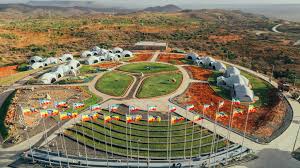
On 31 January 2026, the leaders of Somalia, Ethiopia, and Djibouti jointly inaugurated Shabeely Resort, a landmark tourism and development project in Ethiopia’s Somali Region. The ceremony, attended by Somali President Hassan Sheikh Mohamud, Ethiopian Prime Minister Abiy Ahmed, and Djibouti President Ismail Omar Guelleh, marked more than the opening of a resort; it symbolized a broader ambition to reposition the Horn of Africa as a space of cooperation, connectivity, and shared economic growth.
Located approximately 29 kilometers from Jigjiga, the capital of the Somali Regional State, Shabeely Resort spans 385 hectares and stands as one of the flagship developments under Ethiopia’s Dine for Generations initiative. The project is designed to anchor a wider push for tourism expansion, cross-border trade, and people-to-people exchange in a region that has historically been shaped by fragility, conflict, and chronic underinvestment.
Ethiopian officials describe Shabeely as part of a long-term strategy to unlock the Somali Region’s economic and cultural potential. Situated at a geographic crossroads linking the Red Sea, the Gulf of Aden, and inland East Africa, the region has long been viewed as strategically vital. Yet decades of political fragmentation and insecurity have limited its ability to translate geography into prosperity.
The inauguration coincided with a broader tour by the three leaders of newly developed tourist sites across the Shabelle area, underscoring Ethiopia’s intent to present the Somali Region not as a periphery, but as a central player in the Horn of Africa’s future. The project also comes at a sensitive diplomatic moment. Relations between Somalia and Ethiopia have improved in recent months following tensions triggered by a failed agreement between Ethiopia and Somaliland, while Ethiopian officials have also voiced concern over Somalia’s strengthening ties with Egypt, an influential regional actor with competing interests along the Nile Basin.
Against this backdrop, the symbolism of the three leaders standing together in Jigjiga carried particular weight.
Showcasing Transformation and Cultural Identity
Speaking at the inauguration, President Hassan Sheikh Mohamud highlighted the scale of transformation he has witnessed in the Somali Region over the past decade. Commending the leadership of the Somali Regional State and the federal government of Ethiopia, he emphasized the project’s broad socio-economic impact.
“I visited this city ten years ago, and honestly, the change I see today is remarkable, especially in terms of infrastructure, which is the foundation of development. This project brings many advantages, whether in job creation, economic growth, tourism, or enabling visitors to learn about the culture and way of life of the local community,” said President Hassan Sheikh Mohamud.
Project backers describe Shabeely Resort as a showcase for the Somali Region’s cultural heritage, blending contemporary architectural design with traditional aesthetics rooted in local history. Rather than replicating generic luxury resort models, the development draws inspiration from indigenous forms, materials, and spatial arrangements, presenting Somali culture not as an exhibit, but as a living, evolving identity.
Abiy Ahmed’s Tourism and Development Agenda
Prime Minister Abiy Ahmed described the inauguration of Shabeely Resort as a reflection of Ethiopia’s growing emergence as a leading tourism destination on the African continent. Over recent years, Abiy has increasingly used high-profile project launches to signal Ethiopia’s development ambitions and regional outreach, previously inviting neighboring leaders to major infrastructure milestones such as the Grand Ethiopian Renaissance Dam.
At the ceremony, he emphasized that the Somali Region has become a focal point for large-scale development initiatives. These include the construction of thousands of kilometers of roads, the advancement of gas development projects, and the establishment of industrial ventures such as car assembly plants, efforts aimed at diversifying Ethiopia’s economy and reducing regional inequalities.
He also pointed to ongoing urban renewal in Jigjiga, particularly the corridor development that has reshaped the city’s outlook.
The Prime Minister praised the Somali people’s distinctive architectural approaches and housing construction practices, noting that they offer valuable lessons that could be replicated across other parts of the country. Commending the regional administration’s commitment to both urban and rural development, he described the completion of Shabeely Resort as a source of pride not only for Ethiopia, but for the wider Horn of Africa.
At the same time, Abiy cautioned against complacency. While acknowledging the progress achieved so far, he urged leaders to further elevate Jigjiga’s development and to envision its transformation into a city of continental prominence, stressing that sustained effort will be required to fully realize the region’s potential.
Inside Shabeely Resort: Amenities Designed for Connection
Beyond its political symbolism, Shabeely Resort has been designed as a multifunctional destination that combines leisure, culture, and business.
One of its defining features is a 15.4-kilometer network of shaded pedestrian walkways, carefully landscaped to encourage walking, interaction, and communal life in a climate-appropriate environment. These walkways connect the resort’s various facilities, allowing visitors to move seamlessly between accommodation areas, parks, cultural spaces, and dining venues.
The resort currently features 51 completed accommodation keys, offering modern guest rooms designed to international hospitality standards while maintaining regional design elements. As the project expands, these units are expected to support both domestic and international tourism, as well as conference and business travel.
Dining is anchored by three on-site restaurants with a combined capacity of up to 400 guests. These venues are intended to serve a mix of local Somali cuisine and international offerings, creating spaces where visitors can experience regional flavors while also catering to diverse tastes.
For business and events, Shabeely includes high-tech meeting halls equipped to host conferences, workshops, and regional dialogues, alongside a dedicated cultural venue designed for performances, exhibitions, and community gatherings. These facilities position the resort as more than a leisure destination, but as a hub for intellectual exchange and cultural expression.
Families are also a central part of the design. Children’s play areas and expansive green spaces provide safe, engaging environments for younger visitors, reinforcing the resort’s emphasis on inclusivity and community.
Nature and Heritage
Two unique attractions distinguish Shabeely Resort from conventional developments. The 10,000-tree Fruit Park serves both as a recreational landscape and an agricultural showcase, highlighting sustainable land use while offering shaded, tranquil spaces for visitors. The park also reflects broader efforts to integrate environmental stewardship into tourism development.
Equally distinctive is the Camel Park, an authentic cultural venue celebrating one of the most significant elements of Somali pastoral life. More than an attraction, the Camel Park offers visitors insight into traditional livestock practices, ecological knowledge, and the deep cultural symbolism associated with camels in the region.
According to the Office of the Prime Minister, “The Shabeely project, which is part of the Dine Initiative in the Somali region, with three restaurants serving up to 400 guests, a dedicated cultural venue, high-tech meeting halls, children’s play areas, and shaded walkways across its 15.4 km expanse, Shabeely is designed to foster connection and community.”
With 51 completed keys and world-class hospitality facilities, the Prime Minister’s Office described the resort as a milestone in Ethiopia’s journey to become one of Africa’s top tourist destinations, embodying the Medemer philosophy of growth through collective effort.