By Fu’ad Haji Abdiweli
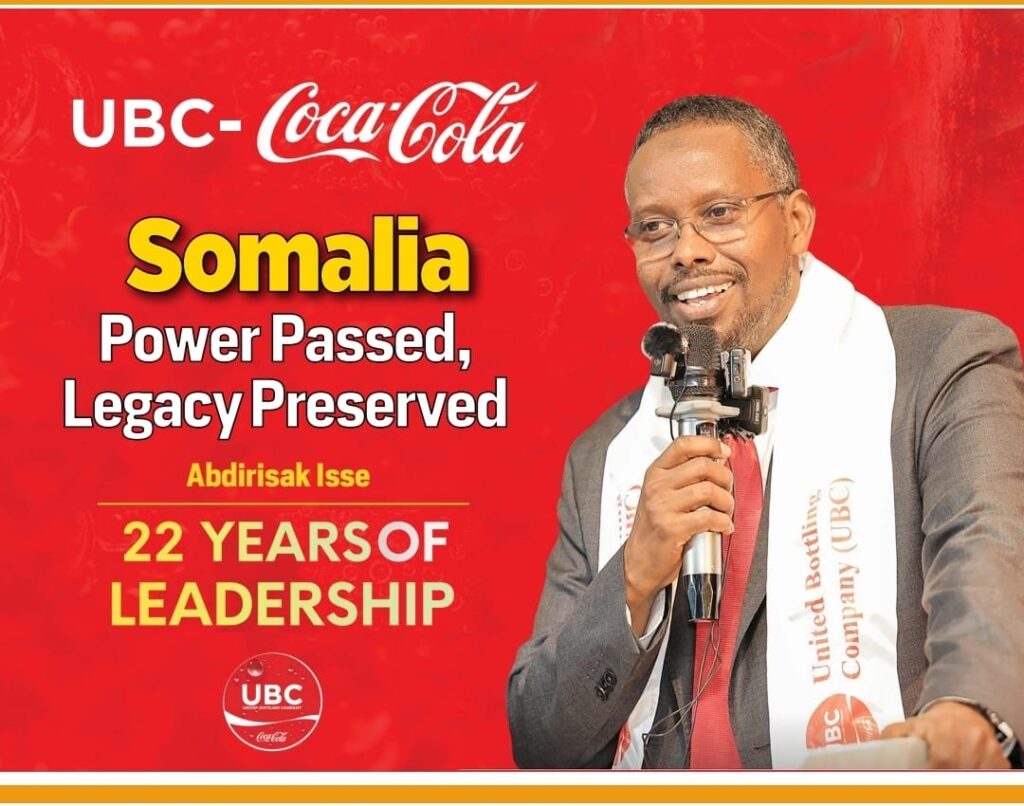
On February 5, 2026, a meticulously organized leadership handover ceremony took place at the Jazeera Hotel in Mogadishu, marking a defining moment in the history of UBC- Coca-Cola Somalia. The event formally transferred the company’s top leadership while honoring more than two decades of visionary stewardship, resilience, and institutional growth within one of the country’s most prominent private sector enterprises. Distinguished government officials, leading business figures, international representatives, company staff, and guests gathered to bid farewell to Mr. Abdirisak Isse, widely known as “Abdirisak Coca-Cola”, the founding Chief Executive Officer of UBC- Coca-Cola Somalia. After 22 years at the helm, he officially handed leadership to Professor Awale, his long-serving deputy, in a transition widely praised for its dignity, continuity, and symbolism for Somalia’s evolving corporate governance culture.
From Scarcity to Vision
In an emotional farewell address, theoutgoing CEO reflected on his earliestencounter with Mogadishu, at a time wheneven access to safe drinking water wasseverely limited.
“When I first arrived in Mogadishu, therewas no clean water to drink. Water had tobe imported at a very high cost. The firstproject I began was establishing a waterpurification plant. People questioned whowould buy the water when many could notafford it. But I saw hospital wards filled withpatients suffering from diseases caused byunsafe water. I believed the money spent onhospitals would instead sustain clean water.I felt it was a responsibility I had to take,and that is how we founded the Saafi watercompany.”
His recollections extended to the fragile national context of 1999, when the UBC Coca-Cola Somalia initiative first began, during a period without a functioning central government and with security largely dependent on individual capacity and resilience. Even as Somalia’s third transitional government emerged from the Arta peace process, the company continued building its foundations, embodying determination in the face of uncertainty.
To prepare a skilled workforce, employees were sent abroad for industrial training, an investment that ultimately enabled the company’s official operational launch in 2004. From those uncertain beginnings, UBC- Coca-Cola Somalia grew into a cornerstone of the local industry.
Transforming Lives and Local Economies
Over two decades, the company’s impact has extended far beyond beverage production. Isse emphasized that UBCCoca- Cola Somalia today directly employs at least 230 Somali staff members, with fully Somali investment underpinning the enterprise. Between 6,000 and 8,000 retail outlets depend on UBC- Coca-Cola products for income generation, while the broader economic ecosystem influenced by the company reaches 10,000 to 15,000 livelihoods, a powerful testament to the private sector contribution in a post-conflict economy.
A Successor Prepared by Experience
In his closing remarks, Isse offered warm praise for Professor Awale, describing him as a principled, highly capable leader and a gifted academic with exceptional mathematical insight. He recalled that competing companies once sought Awale’s expertise with stronger financial incentives, yet Awale chose to remain, an act Isse described as a personal honor now culminating in the transfer of leadership.
Government Recognition and Support for Industry
Among the keynote speakers was Somalia’s Minister of Commerce and Industry, Jamaal Mohamed Hassan, who hailed the peaceful and orderly transfer of authority within one of the country’s largest factories as a milestone worth celebrating.
He reaffirmed the government’s commitment to supporting Somali entrepreneurs through:
- Regulatory facilitation for industrial
- Tax incentives for new factories
- Rapid processing of licenses and permits
“To Somali businesspeople, especially those in the industrial sector, I want to assure you that the government is committed to making the business environment easier. We will introduce key incentives, including tax exemptions, licenses, and permits that once took months will soon be processed within hours,” said the minister.
These pledges signal an increasingly enabling environment for private-sector expansion, an essential ingredient for long-term national recovery and growth.
UBC-Coca-Cola Somalia: A Story of Resilience and Growth
Officially operational since 2004, UBC Coca-Cola Somalia emerged during one of the country’s most challenging eras, marked by:
- Widespread insecurity
- Destroyed commercial infrastructure
- Deep skepticism toward private investment
Yet through long-term vision, persistence, and business innovation, the company overcame these barriers to become one of the largest Coca-Cola operations in the Horn of Africa, a historic achievement reflecting Somali entrepreneurial determination.
Twenty-Two Years of Transformational Leadership
Isse’s 22-year tenure stands as a period defined by:
- Transparent and accountable management
- Innovative, forward-looking leadership
- Continuous expansion
- Creation of thousands of employment opportunities
Under his guidance, UBC- Coca-Cola Somalia evolved into a flagship example of Somali private enterprise, contributing to economic recovery, strengthening investor confidence, and supporting community development initiatives.
From Private-Sector Pioneer to Public-Sector Hope
Speakers at the ceremony repeatedly described Isse as a visionary pioneer whose achievements in business suggest strong potential for future national service. There is widespread optimism that his leadership qualities, integrity, strategic thinking, and commitment to public welfare will translate effectively into the public sector, where expectations for reform-minded governance remain high.
Prayers and well-wishes accompanied his departure, reflecting both gratitude for past achievements and hope for continued service to the nation.
A New Chapter Begins
For Professor Awale, assuming leadership represents not a rupture but a continuation. Having long served within the company’s senior management, he brings deep institutional knowledge and strategic continuity, ensuring:
- A calm and stable leadership transition
- Preservation of a successful long-term strategy
- Strong confidence in the company’s future
This peaceful transfer of authority symbolizes the growing maturity of Somali private institutions and highlights the importance of leadership succession grounded in competence, vision, and trust.
UBC- Coca-Cola Somalia remains more than a manufacturing enterprise; it is a living testament to what Somali entrepreneurship can achieve despite adversity. Its journey, from insecurity and scarcity to stability and regional prominence, demonstrates that resilient leadership, local investment, and long-term vision can overcome even the most daunting conditions.