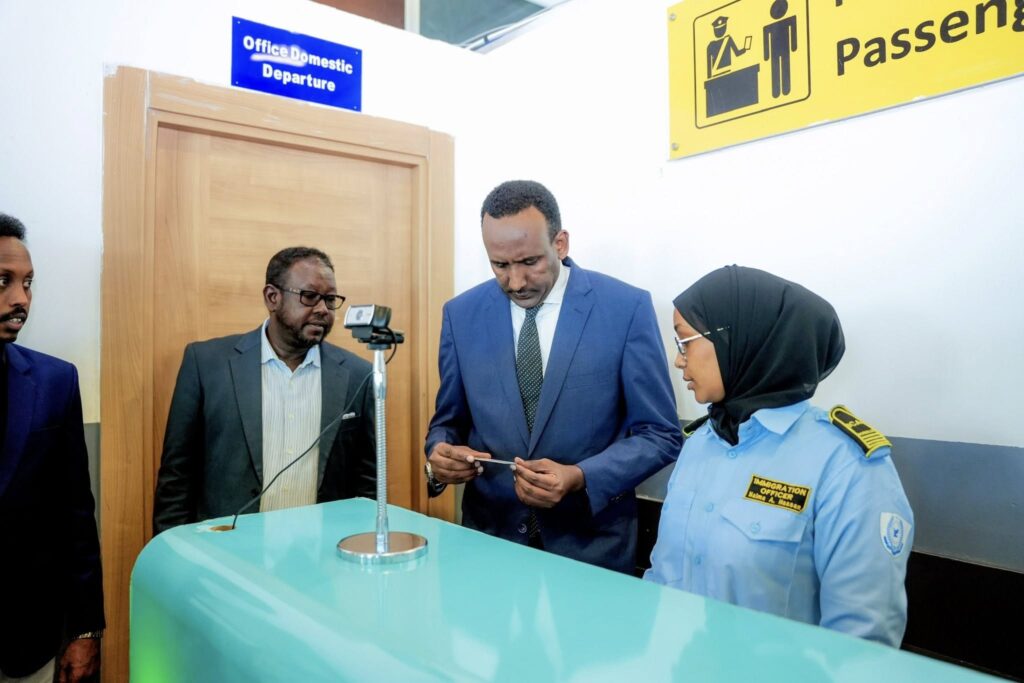
On March 2, Somalia marked a quiet but transformative milestone in its state-building journey. The Director-General of the Somali Immigration and Citizenship Agency (ICA), Mustafa Duhulow, officially launched the implementation of the National Identity Card for Domestic Travel, a reform aimed at strengthening internal mobility management, enhancing border security, and modernizing the country’s travel systems.
The launch ceremony took place at the domestic departures’ terminal, where the Director-General received a detailed briefing from the Border Department on the new procedures, technical readiness, and measures put in place to ensure a smooth transition for Somali citizens traveling within the country.
That same morning, the first passengers were formally processed under the new system using their National ID cards, an operational moment that signaled the beginning of a new chapter in regulated, accountable domestic travel.
Why does it matter?
For decades, internal movement in Somalia has been shaped by informal systems, inconsistent documentation, and limited oversight. The introduction of a standardized National ID requirement for domestic flights is more than an administrative change; it is a structural reform.
According to Director-General Mustafa Duhulow, the system will:
- Strengthen internal migration management
- Enhance border and aviation security
- Improve the monitoring of passenger movement in accordance with the law
- Increase efficiency and transparency in service delivery
“This implementation will play a critical role in improving domestic travel management, strengthening border security, and tracking movement in line with legal procedures,” he noted in a public statement.
At the same time, he urged immigration officers to exercise patience and professionalism as citizens adjust to the new requirements, underscoring that modernization must go hand in hand with public trust.
The National Identification and Registration Authority (NIRA) of Somalia has now registered more than one million people for National IDs, a milestone that underscores growing public participation in state systems and marks one of the most significant identity-registration efforts in the country’s history.
This achievement not only lays the groundwork for improved internal mobility but also enhances:
- Access to government services
- Citizen engagement with state institutions
- Data quality for planning and governance
- Financial inclusion and legal recognition
International Alignment
The March 2 rollout did not occur in isolation. It is part of a broader modernization strategy within the ICA. On March 3, Director-General Mustafa Duhulow hosted James Swan, the UN Special Representative for Somalia and Head of United Nations Support Office in Somalia (UNSOS), for high-level discussions on immigration reforms.
During the meeting, the ICA leadership presented recent advancements, including:
- Integrated border security management
- Digitization of residency services
- Modernized passport issuance
- The launch of Somalia’s electronic visa system (e-Visa/eTAS)
James Swan welcomed the progress, highlighting the importance of modern, secure migration systems for international cooperation and operational efficiency.
Somalia’s E-Visa Revolution
The domestic National ID rollout complements another landmark reform introduced in August 2025: Somalia’s E-Visa/eTAS system, which became mandatory for foreign arrivals in September 2025.
Through the ICA’s official online portal, foreign nationals can now apply electronically from anywhere in the world. According to ICA officials, the system allows Somalia to:
- Access passenger information before arrival
- Verify applicant data globally
- Monitor and track applications securely
- Consolidate visa revenue into a transparent, centralized system
Director-General Duhulow described the e-Visa launch as a “historic stride,” emphasizing that it aligns Somalia with international best practices adopted by countries across Africa, Europe, Asia, and North America.
The Minister of Internal Security, Abdullahi Sheikh Ismail Fartaag, reinforced that the system strengthens national security while enhancing financial accountability. All visa revenues are deposited directly into Ministry of Finance accounts, minimizing leakages and increasing transparency.
Globally, electronic travel authorization systems have become hallmarks of modern governance. From Kenya to Turkey, India to the United States, digital visa platforms allow governments to balance openness with security. Somalia’s adoption of such systems signals its readiness to operate within international standards.
Combating Human Trafficking
The modernization push is also reflected in enforcement efforts. On February 25, 2026, the ICA thwarted an attempted human trafficking operation involving a Somali girl who was being unlawfully transported toward Libya.
Investigations revealed that traffickers had attempted to fraudulently process travel documents. The case was handed over to the Criminal Investigation Department (CID) for further legal action.
The incident underscores the link between documentation reform and citizen protection. Stronger identity systems and border controls not only regulate travel, but they also save lives.
“Protecting Somali citizens is a national duty,” the agency affirmed in a public statement.