In a world that is increasingly recognizing the importance of inclusion, conversations about autism are no longer optional—they are essential. Autism is not a disease to be cured, but a neurodevelopmental difference to be understood, supported, and embraced. Yet in many societies, including Somalia, stigma, misinformation, and weak support systems continue to push children and families living with autism to the margins. Changing this reality requires more than awareness; it demands meaningful inclusion.
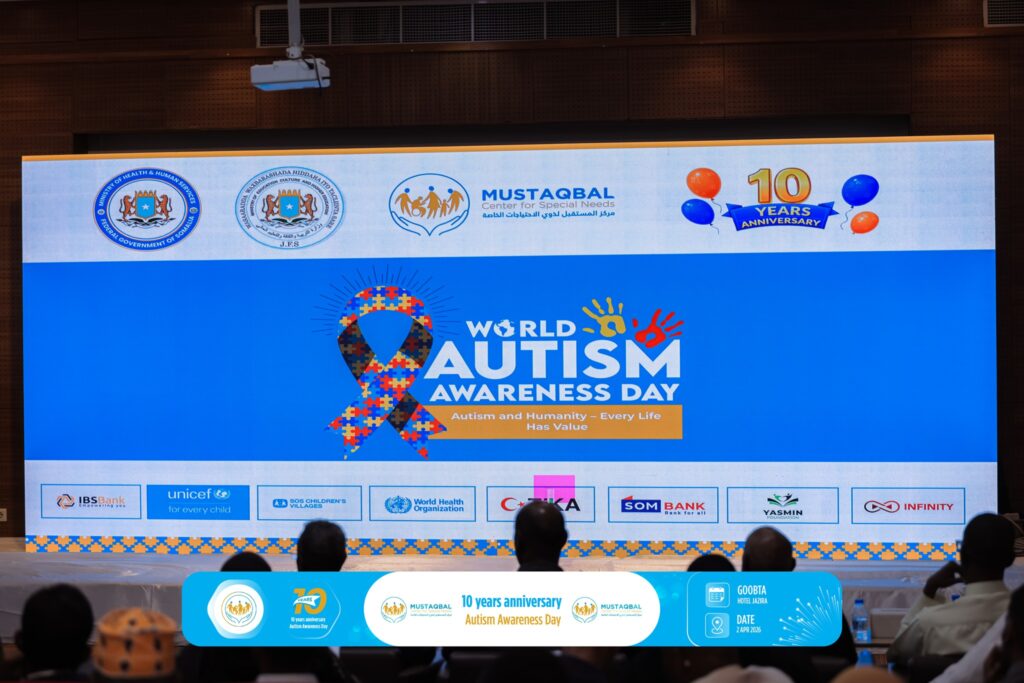
It is within this context that institutions such as Mustaqbal Foundation (Mustaqbal Center for Special Needs) stand out as a powerful example of what is possible. Recently in Mogadishu, the foundation marked its 10th anniversary alongside World Autism Awareness Day, bringing together government officials, educators, civil society leaders, medical professionals, and advocates under a common purpose: advancing the rights, dignity, and opportunities of children with autism.
Over the past decade, Mustaqbal Foundation has worked to address critical gaps in special needs services by providing education, therapy, care, and psychosocial support for children with autism and related conditions. Its work is significant not only in practical terms, but also in what it represents. The foundation has shown that when children with autism are given structured support, understanding, and a safe environment, they can learn, grow, and participate meaningfully in society. In doing so, it has helped challenge harmful misconceptions that too often lead to isolation and exclusion.
The anniversary event also reflected the growing recognition of autism as an urgent social issue. It was officially opened by the founder of Mustaqbal Foundation, Dr. Raxmo Abbdulkadir Mohamed, who spoke passionately about the importance of supporting children with autism and the progress the organization has made since its establishment. Her remarks highlighted both the achievements of the center and the continuing need for stronger commitment from all sectors of society.
Other distinguished guests and officials who attended the event also praised the important role Mustaqbal Foundation plays in the community, particularly in supporting children with special needs and giving hope to families who have often had nowhere else to turn. Their presence sent a strong message that the issue of autism is no longer one to be ignored, but one that deserves national attention and action.
Among the senior officials present was the Minister of Justice and Constitution, Hassan Mo’allim who emphasized the importance the government places on protecting the rights of children with autism and supporting organizations working in this field. His remarks reflected an encouraging shift toward greater public acknowledgment of the challenges faced by children with special needs and the institutions that serve them.
Still, the road toward full inclusion remains long and uneven. In Somalia, as in many African societies, autism is still widely misunderstood. Families often face stigma, silence, and social pressure. Access to early diagnosis, specialized education, therapy, and trained professionals remains limited. Inadequate infrastructure and lack of sustained public investment continue to make support difficult for many children who need it most. These barriers underline the urgent need to move beyond conversation and toward real commitment.
This is why awareness alone is not enough. Governments, schools, health institutions, and communities must invest in long-term solutions. Somalia needs more schools equipped to support children with special needs, more trained teachers and therapists, more accessible diagnostic and intervention services, and wider public education campaigns to normalize autism and fight stigma. Inclusion should not depend on the dedication of a few institutions alone; it must become part of national planning and public responsibility.
Medical professionals continue to stress that early intervention and acceptance are key to helping children on the autism spectrum reach their full potential. As Dr. Abdirahman Yusuf, a pediatric specialist based in Mogadishu, noted: “Autism is not a limitation of potential; it is a call for tailored support. When communities understand this, children on the spectrum are no longer hidden; they are empowered.” His words capture an essential truth: inclusion is not charity—it is a social obligation.
Ultimately, autism is not only a medical or educational issue. It is a human issue. It challenges society to rethink how it defines ability, intelligence, and belonging. It asks whether children with autism will continue to be seen through the lens of limitation, or whether they will be recognized for their potential and their right to thrive.
As Mustaqbal Foundation celebrates a decade of service and impact, it also shines a light on the work still ahead. Its example reminds us that progress is possible when compassion is matched with action. The true measure of advancement will not be how much society talks about autism, but how fully it includes, supports, and empowers those living with it