By Fuad Haji Abdiweli
Somalia is steadily charting a path toward economic recovery, and infrastructure development has emerged as a central pillar of that resurgence.
At the heart of this transformation is Mogadishu’s Aden Adde International Airport, where the recent inauguration of the country’s first Commercially Important Person (CIP) terminal signals far more than the opening of a new facility. It reflects a nation rebuilding confidence, connectivity, and commerce after decades of disruption.
The newly opened Arimas CIP Terminal forms part of Somalia’s broader strategy to position Mogadishu as a competitive regional aviation hub alongside established centers such as Nairobi and Addis Ababa. For a country long associated with instability, the development represents a visible shift toward modernization, investment attraction, and deeper engagement with global markets.
Prime Minister Hamza Abdi Barre, who officiated the ribbon-cutting ceremony, emphasized the deeper economic significance of the project.
“Air travel is not merely about transportation. It is the bridge that connects Somalia to regional markets, global partners, and investment opportunities,” he said during the inauguration. “A modern aviation sector strengthens our economic growth, enhances trade, and reinforces our country’s linkage to the world.”
For decades, Aden Adde International Airport has served as Somalia’s primary gateway to the outside world. Positioned along the Indian Ocean and located strategically between Africa, the Middle East, and Asia, the airport plays a critical role in connecting Somalia to international markets, diplomatic missions, humanitarian operations, and the global Somali diaspora.
In recent years, the airport has undergone gradual transformation. Infrastructure improvements, expanded airline connectivity, and enhanced operational systems have helped reshape it into a growing aviation hub in the Horn of Africa.
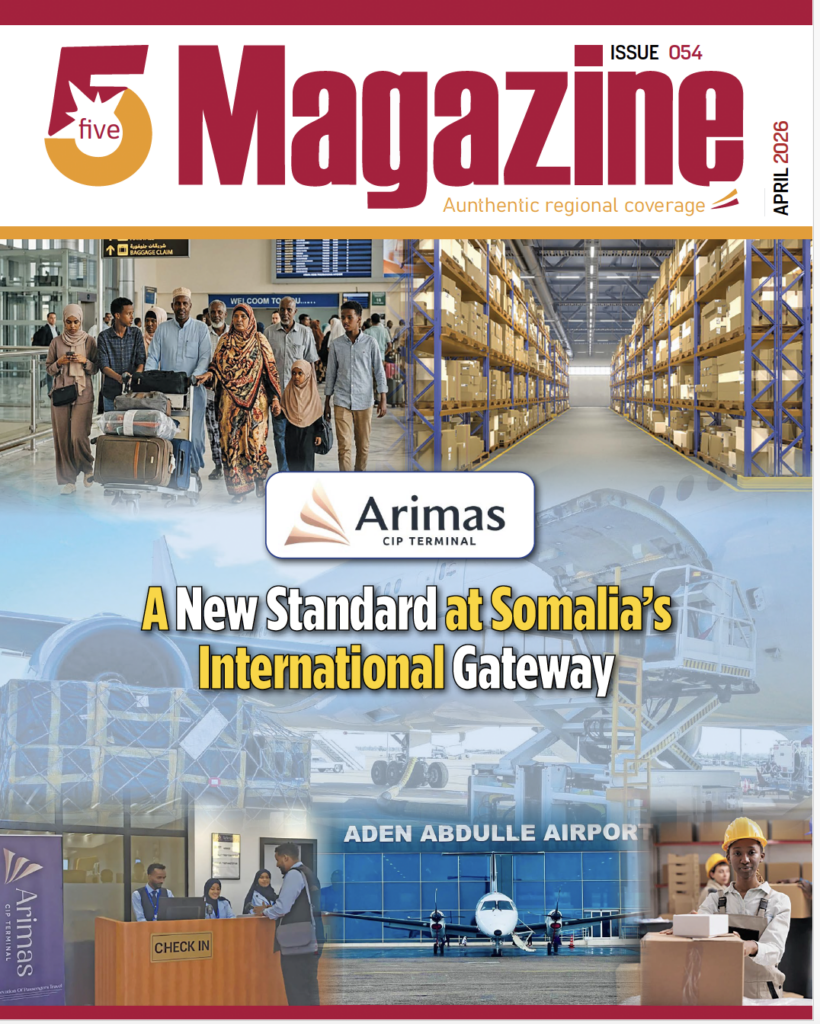
Within this evolving landscape, the Arimas CIP Terminal introduces a new layer of sophistication to Mogadishu’s aviation ecosystem. Designed as a multi-service aviation facility, the terminal integrates premium passenger handling, cargo logistics capabilities, and aviation support infrastructure under a single operational vision.
The CIP terminal itself is designed to decongest the main passenger facility while elevating service standards to international benchmarks. Built with contemporary architectural design and modern operational systems, it caters primarily to business travelers, diplomats, government officials, and high-profile passengers.
Passengers traveling through the facility benefit from streamlined and personalized services, including dedicated check-in, fast-track immigration and security processing, private lounges, meeting rooms, and direct transfers to aircraft. Trained hospitality staff coordinate the entire travel process, ensuring that formalities such as customs and immigration procedures are handled efficiently and discreetly.
Inside the terminal, carefully designed lounge areas provide a calm and comfortable environment that contrasts with the busy atmosphere of traditional airport terminals. Amenities such as high-speed internet, private meeting rooms, and relaxation spaces allow travelers to conduct business or rest before their flights.
The goal, airport officials say, is to transform the airport journey into a seamless and managed experience from arrival at the airport to boarding the aircraft.
Beyond passenger services, the Arimas development also contributes to strengthening Mogadishu’s cargo and logistics infrastructure. Air cargo plays an essential role in Somalia’s economy, facilitating the movement of humanitarian aid, medical supplies, commercial imports, and time-sensitive goods.
To support these operations, the project includes a cargo warehouse equipped with organized handling systems and secure storage areas. The facility provides space for general cargo, temperature-controlled storage for perishable goods, and bonded cargo zones where goods can be processed and inspected efficiently.
With controlled access systems and continuous monitoring, the warehouse aims to provide a reliable logistics platform for airlines, freight forwarders, importers, exporters, and humanitarian organizations operating through Aden Adde International Airport.
Another component of the Arimas ecosystem is the development of infrastructure for aircraft maintenance operations. The project includes dedicated hangar space designed to support Maintenance, Repair, and Overhaul (MRO) activities conducted by licensed aviation service providers.
Access to such facilities is increasingly important as airline traffic continues to grow. Maintenance infrastructure allows routine inspections, servicing, and technical operations to be carried out locally, improving efficiency for airlines operating through Mogadishu.
Together, these elements, premium passenger services, cargo logistics infrastructure, and aviation maintenance support, reflect a broader ambition to modernize Somalia’s aviation sector and align it with international standards.
Adding to the optimism surrounding the development, Aden Ali Mohammed, a business analyst, noted that Somalia stands at a turning point in its economic trajectory.
“Somalia has enormous untapped potential to transform itself into a regional economic hub,” he said. “The modernization of Mogadishu airport marks a starting point. It sends a clear message that the country is open for business, investment, and partnership.”
The airport expansion comes amid wider economic progress across the country. Somalia has increased trade with neighboring countries, strengthening commercial ties throughout the Horn of Africa and the broader East African region. Cross-border commerce in livestock, agricultural produce, and manufactured goods has expanded steadily, supported by improvements in transportation networks and logistics infrastructure.
The ongoing modernization of the Port of Mogadishu has also played an important role in boosting economic activity. Improved cargo handling capacity and operational efficiency have strengthened the port’s ability to support regional trade while increasing government revenue.
Security gains have further reinforced this economic revival. While challenges remain, Somalia has seen a decline in large-scale terrorist attacks compared to previous years. These improvements have contributed to a more stable environment for business operations, diaspora investment, and international partnerships.
The Arimas CIP Terminal, financed by Somali investors, underscores growing private-sector confidence in the country’s recovery trajectory. Its development highlights the role that domestic entrepreneurship and investment can play in rebuilding critical national infrastructure.
Combined with improvements in port operations, expanding regional trade networks, and gradual stabilization across key sectors, the airport project symbolizes more than aviation progress. It represents a country steadily rebuilding its economic foundations and repositioning itself within regional and global markets.
As Somalia continues its journey of reconstruction and development, strategic infrastructure such as airports will remain central to the country’s growth. They serve not only as transportation hubs but also as gateways for commerce, diplomacy, and international cooperation.
With developments like the Arimas CIP Terminal, Mogadishu is taking visible steps toward strengthening its role as a regional gateway for trade, travel, and investment in the Horn of Africa.