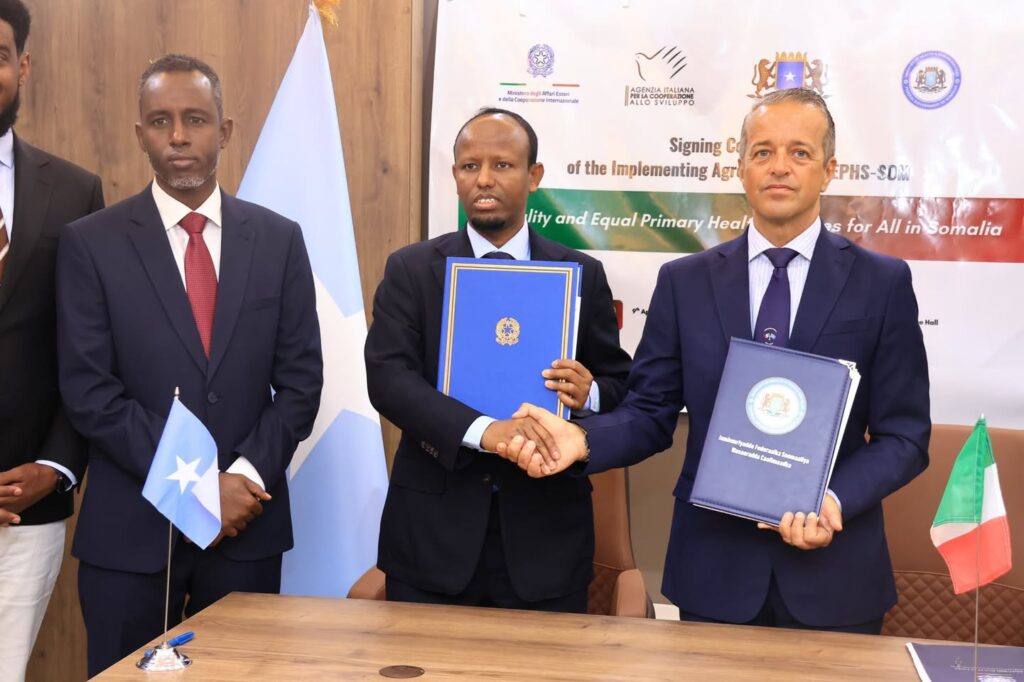
The Minister of Health and Human Services of the Federal Government of Somalia, H.E. Dr. Ali Haji Aden, and the Ambassador of Italy, Amb. Pier Mario Daccò Coppi, accompanied by representatives from the Italian Agency for Development Cooperation (AICS), officially signed an important agreement to implement the QEPHS-SOM Project, which focuses on strengthening primary healthcare services across the country.
The important signing ceremony took place at the conference hall of the Ministry of Health and was attended by the outgoing Director General of the Ministry of Health, Dr. Guled Abdijalil, departmental directors, and several staff members from the Ministry of Health and Human Services of the Federal Government of Somalia. On the Italian side, the event was also attended by the Head of the Italian Agency for Development Cooperation (AICS), Mr. Fabio Minniti, and an official from the agency, Mr. Alessandro Dadomo. These officials played an important role in the implementation and formalization of the agreement.
This agreement marks a major step toward strengthening Somalia’s health system, particularly in the area of essential primary healthcare services that directly affect communities. The QEPHS-SOM Project is designed to ensure that all Somali communities have access to quality, reliable, and equitable healthcare services. It places particular emphasis on reducing the gap between urban and rural areas so that health services can reach the communities with the greatest need.
The QEPHS-SOM Project is fully funded by the Government of Italy, once again demonstrating Italy’s commitment to supporting Somalia’s development, particularly in vital social sectors such as healthcare. This partnership between Somalia and Italy reflects a historic relationship that has endured for many years, and this new agreement further strengthens that cooperation, paving the way for practical collaboration aimed at achieving sustainable development.
Officials who spoke during the signing ceremony highlighted the significance of the project, noting that it will make a substantial contribution to addressing the challenges facing Somalia’s health system. They emphasized that the project will help reduce maternal and child mortality, expand access to healthcare services, and improve the overall well-being of the Somali people.
In conclusion, this agreement represents the Somali government’s continued commitment to rebuilding and developing the national health system through strengthened international cooperation. It is expected that the implementation of the QEPHS-SOM Project will bring visible improvements in the quality and delivery of healthcare services, directly impacting the lives of millions of Somalis and helping ensure that every person receives the adequate healthcare they deserve.