By 5 Magazine
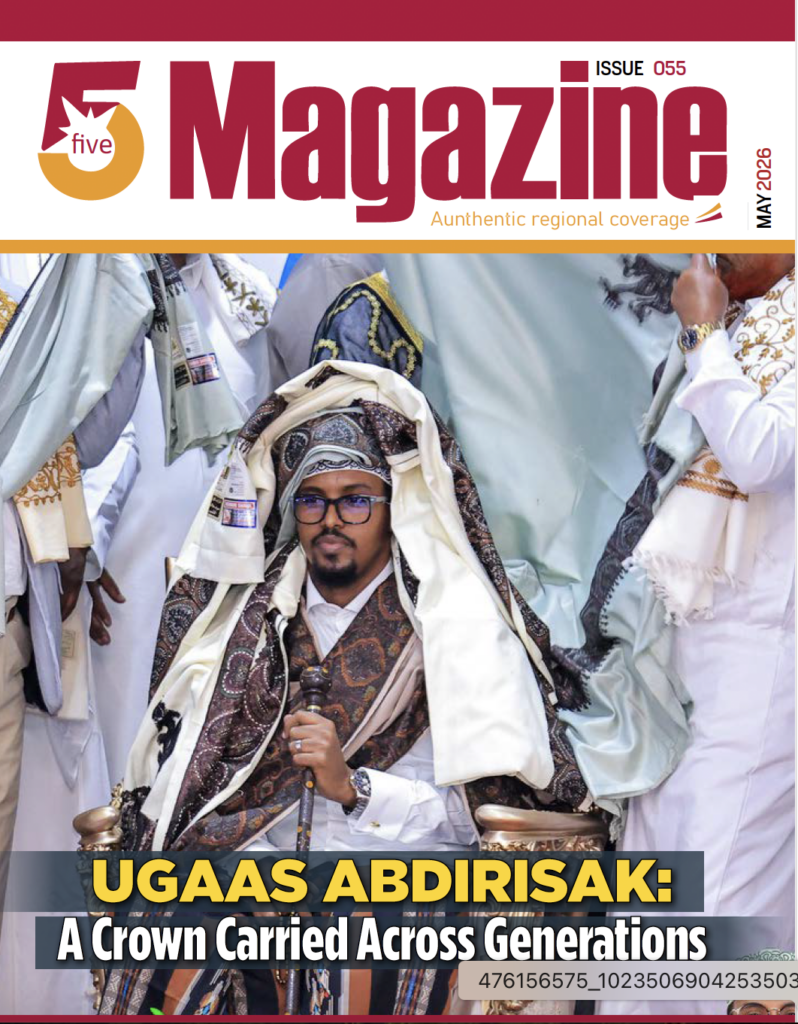
On April 25, 2026, in Mogadishu, a ceremony unfolded that was at once contemporary and ancient, political and deeply cultural, personal and profoundly national. The official coronation of Ugaas Abdirisak Ugaas Abdullahi Ugaas Hashi Ugaas Faraadde was not simply the installation of a traditional leader; it was the continuation of a lineage, the renewal of a social contract, and a vivid demonstration that Somali traditional authority, far from fading, remains embedded at the very heart of the nation’s identity.
The gathering itself told a story before a single speech was delivered. Present were senior officials of the Federal Government of Somalia, including President Hassan Sheikh Mohamud, alongside former presidents, former prime ministers, regional leaders, traditional elders from across Somalia and the diaspora, scholars, business leaders, and respected community figures. In a country often described through narratives of division, the sheer diversity and stature of those present signalled something else entirely: continuity, recognition, and shared respect for the enduring authority of tradition.
The ceremony was deliberately rich in cultural expression. It was not merely organised—it was curated to reflect Somali identity in its fullest sense. The presence of traditional elders, the formality of speeches, the reverence shown to lineage, and the collective acknowledgement of responsibility all reflected a deeper truth: in Somali society, leadership is never detached from history. It is inherited, tested, and reaffirmed in moments like this.
Speakers repeatedly returned to one central theme: the importance of traditional leadership as a stabilising force in Somali society. Their remarks were not abstract or ceremonial; they were grounded in lived experience, in decades of conflict resolution, reconciliation, and community governance that have often taken place outside formal institutions.
Former Prime Minister Ali Mohamed Gedi captured this relationship between tradition and statehood in direct and unambiguous terms:
“I congratulate the Ugaas, and I thank everyone who attended his coronation. As politicians, we recognise Somali traditional leaders as the most important pillars of the country’s nationhood. Therefore, I advise government leaders to always respect them in that way.”
His statement reflects a long-standing reality within Somali governance. For centuries, before colonial administrations and modern state structures, Somali communities were governed through systems rooted in xeer—customary law administered by elders, Ugaasyada, Suldaans, Malaaqyo, and other traditional authorities. These systems regulated everything from conflict resolution to resource sharing, often with a level of legitimacy that modern institutions still strive to achieve. Gedi’s words underscore the idea that contemporary Somali politics does not replace tradition—it depends on it.
This theme was further expanded by former Prime Minister Abdi Farah Shirdoon, who articulated a deeply rooted Somali philosophy linking governance, justice, and development:
“I wish that Allah makes your work easy and that you succeed in good traditional leadership. When traditional administration improves, it brings social justice. When social justice is achieved, there is peace. When peace is achieved, there is development. When development is achieved, there is good politics.”
What Shirdoon describes here is not simply a sequence; it is a worldview. In many Western political frameworks, governance begins at the top, with institutions imposing order downward. In Somali tradition, the model is reversed. Stability begins within communities, through fairness, accountability, and shared norms. Only then can peace take root, followed by development and functioning political systems. His statement echoes centuries of Somali societal organisation, where legitimacy is built from the ground up rather than imposed from above.
Yet the tone of the ceremony was not purely celebratory. There was also a clear recognition of the weight of responsibility being placed upon the new Ugaas. Former Prime Minister Mohamed Hussein Roble addressed this directly, grounding the moment in the realities facing the country:
“During the time I was in office, I was a very close friend of your father. I say to you, welcome. Looking at the situation the country is in, and where things stand, it is more important to pray for you than to congratulate you. So we pray for you.”
Roble’s words introduce a sobering perspective. Leadership, particularly in the Somali context, is not ceremonial; it is deeply demanding. The acknowledgment that prayer may be more important than congratulations reflects the challenges ahead: navigating complex social dynamics, resolving disputes, maintaining unity, and upholding justice in a rapidly changing environment. It is also a reminder that traditional leaders operate within both spiritual and social expectations, accountable not only to their communities but also to moral and religious standards.
The scope of the Ugaas’s role was also expanded beyond clan boundaries. Deputy Prime Minister Salah Ahmed Jama emphasized that the significance of the position extends far beyond a single lineage:
“The Ugaas is not only a leader of his clan, he is a leader of all Somali people. I pray to Allah to support him in this responsibility and make him someone who benefits his community and the entire nation and serves for a long time.”
This statement reflects an evolving understanding of traditional leadership in modern Somalia. While historically rooted in specific clans or communities, figures like the Ugaas increasingly serve as mediators and symbols of unity across broader national contexts. Their influence is often called upon in moments of inter-clan conflict, national reconciliation, and political transition, making their role both local and national.
For Ahmed Abdi Kariye, the event carried personal and administrative significance:
“For me, I am different from others, because I carry a special responsibility regarding the Ugaas and his coronation. The Ugaas is specifically a leader for a community that lives in the administration I lead. That community has always had a major role in Somalia, but this event they organised today and the way it brought Somalis together shows that their role is valuable and that they have a significant place in the nation.”
His remarks highlight how traditional authority intersects with federal governance structures. Regional administrations often rely on traditional leaders to maintain cohesion, resolve disputes, and foster cooperation within their jurisdictions. The acknowledgement of the community’s role also reflects a broader Somali cultural value: collective identity and contribution are deeply intertwined.
Former President Sharif Sheikh Ahmed brought a historical lens to the discussion:
“I congratulate the Ugaas and his community and thank them for organising this event that has brought together people who might not have met, considering the time we are in. Somali traditional leaders have been a pillar and a cause of the foundation of the current state, and I hope they play their role in protecting statehood.”
His statement connects past and present, reminding the audience that Somalia’s modern statehood did not emerge in isolation. Traditional leaders played key roles in peace conferences, reconciliation processes, and the rebuilding of governance structures following decades of conflict. Their authority, rooted in legitimacy and trust, often enabled negotiations that formal institutions could not achieve alone.
The expectations placed upon the new Ugaas were further articulated by former Prime Minister Hassan Ali Khaire:
“I send my congratulations to the Ugaas of the Murusade, Ugaas Abdirisak Ugaas Abdullahi. I pray that Allah supports Ugaas Abdirisak in the heavy responsibility he has been crowned with today and makes him a leader known for responsibility, honesty, capability, transparency, and patience, and one who works for peace, unity, and development.”
This enumeration of qualities reflects a moral framework deeply embedded in Somali leadership expectations. A Ugaas is not judged solely by lineage, but by conduct, his ability to embody fairness, patience, and integrity in all dealings.
Prime Minister Hamza Abdi Barre further distilled these expectations into three essential qualities:
“Ugaas, I congratulate you on this valuable position that this respected community has entrusted to you and crowned you with. Secondly, I pray that Allah supports you in this great responsibility placed upon you. Tradition is based on qualities that must be present, the foremost being courage, generosity, and justice. When these three are combined, they create dignity and honour for the Ugaas. I hope these three qualities are complete in you.”
These qualities, courage, generosity, and justice, are not arbitrary. They are foundational principles within Somali culture, often referenced in poetry, oral tradition, and communal expectations. Together, they define what it means to lead.
When Ugaas Abdirisak himself spoke, his tone was one of humility and awareness:
“I congratulate everyone who attended this ceremony, especially the President of the Federal Republic of Somalia, Hassan Sheikh Mohamud. Today is a day that will enter a golden page in history. I hope Allah makes this gathering one of blessings. I also especially thank the distinguished guests who travelled long distances to join us.”
“Today, a very great responsibility has been placed on me. I hope Allah accepts the prayers you made for me and helps me fulfil this responsibility. I am a young man. The name and position I hold is not something I worked for; it was built for me by my father, my grandfathers, and those before them. I am ready to double the name and honour they created for me. I will continue to respect, dignity, and service to the people.”
His acknowledgement of inherited legacy reflects a central principle in Somali traditional leadership: authority is cumulative. It is built across generations, maintained through conduct, and judged by continuity.
President Hassan Sheikh Mohamud framed the event within a broader national narrative:
“The way this ceremony brought together the Somali elite shows that our people are united in shared lineage, religion, culture, and Somali identity. We place special importance on working with traditional leadership, because they are the backbone of reconciliation, state-building, and stability.”
“I urge kings, Ugaas, Imams, Malaaqs, and all Somali traditional leaders present here to dedicate their time to uniting society and preserving our noble values, so that we can achieve a peaceful, developed, prosperous, and united Somalia.”
“This ceremony brought together Somali traditional leaders from everywhere. Therefore, I add to his name — I call him Ugaas the Unifier. It is a strong symbol and message that disproves claims that Somalis are divided and not united.”
Finally, former President Mohamed Abdullahi Farmaajo offered his congratulations:
“It is an honour for me to congratulate Ugaas Abdirisak Ugaas Abdullahi Ugaas Hashi Ugaas Faraadde, whose coronation took place today in Mogadishu. I pray that Allah supports him in leading this historic sultanate.”
The coronation of Ugaas Abdirisak was not simply about one individual assuming a title. It was about the endurance of a system that has guided Somali society for centuries, a system rooted in lineage, legitimacy, and lived experience.
In a world that often equates progress with the abandonment of tradition, this event offered a different perspective: that tradition, when grounded in justice and adapted to modern realities, remains not only relevant but essential.