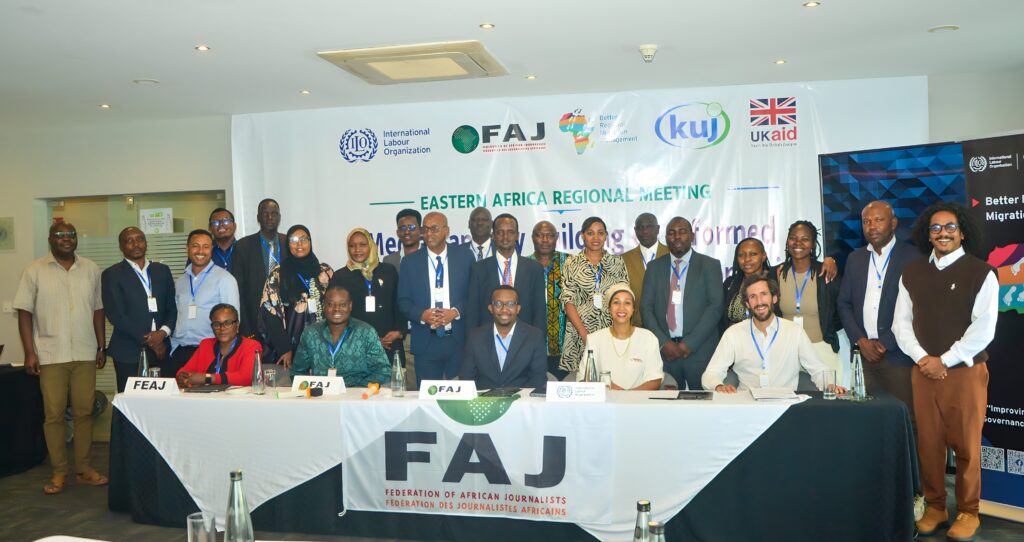
Journalist leaders from ten Eastern African countries have committed to advancing accurate, ethical and evidence-based reporting on migration and labour mobility following a high-level regional meeting in Mombasa.
The three-day Eastern Africa Regional meeting on Media Capacity Building on Informed Migration Narratives and Local Opportunities brought together leaders of journalists’ unions, editors and media practitioners from Comoros, Djibouti, Ethiopia, Kenya, Rwanda, Somalia, South Sudan, Sudan, Tanzania and Uganda.
Organised by the Federation of African Journalists (FAJ) in collaboration with the Federation of Eastern Africa Journalists (FEAJ), the forum sought to strengthen media capacity to report migration issues responsibly amid rising concerns over misinformation, human trafficking and irregular migration across the region.
The meeting was supported by the International Labour Organization (ILO) through the Better Regional Migration Management (BRMM) Programme, funded by the United Kingdom’s Foreign, Commonwealth and Development Office (FCDO).
Eastern Africa remains one of the continent’s most dynamic migration corridors, serving simultaneously as a source, transit and destination region for migrants and workers seeking economic opportunities. Labour mobility continues to play a significant role in regional integration, economic development and household livelihoods, but has also exposed thousands to exploitation, unsafe migration routes and trafficking networks.
Speaking during the meeting, ILO BRMM Chief Technical Advisor Aida Awel underscored the importance of professional journalism in shaping public understanding of migration.
“By equipping journalists with the knowledge and tools to report accurately and responsibly, we are contributing to greater public awareness, accountability and regional cooperation on issues that affect millions,” she said.
FAJ President Omar Faruk Osman challenged journalists to counter misleading narratives surrounding migration and provide audiences with verified information.
“Migration is one of the most significant public interest issues facing Africa today. Journalists have a responsibility to report it accurately and responsibly by exposing the risks of irregular migration and exploitation while highlighting opportunities available within our countries and across the region,” Osman said.
Participants examined migration trends, labour mobility patterns and socio-economic drivers influencing migration flows across Eastern Africa. Deliberations focused on strengthening public-interest journalism, improving fact-checking and verification practices, and ensuring migration coverage reflects both opportunities and challenges.
A key highlight of the forum was the regional launch of the ILO Toolkit on Migration Reporting, a practical guide designed to support journalists in producing accurate, ethical and context-sensitive stories on migration and labour mobility.
The conference also explored the role of the media in raising awareness about fair recruitment practices, legal labour migration pathways, skills development, entrepreneurship and employment opportunities available within the region.
The meeting culminated in the adoption of the Mombasa Statement on Responsible Migration Reporting, through which journalists pledged to uphold editorial independence, strengthen information integrity, promote balanced reporting and deepen cross-border collaboration among media professionals.
The declaration is expected to reinforce continental efforts already underway through the Dakar Communiqué on Labour Migration Reporting and the Kigali Action Plan on Communicating Labour Migration and Mobility in Africa.
As migration continues to shape Africa’s economic and social landscape, media leaders said responsible journalism will remain critical in ensuring public discourse is guided by facts, evidence and the public interest rather than misinformation and false promises.