Since returning to power in May 2022, President Hassan Sheikh Mohamud has led Somalia through a period marked by significant political, security, and economic transformation. His administration—often referred to as the “DanQaran Government”—has focused on rebuilding state institutions, combating extremism, and restoring Somalia’s position on the global stage.
Security Gains and the Fight Against Al-Shabaab
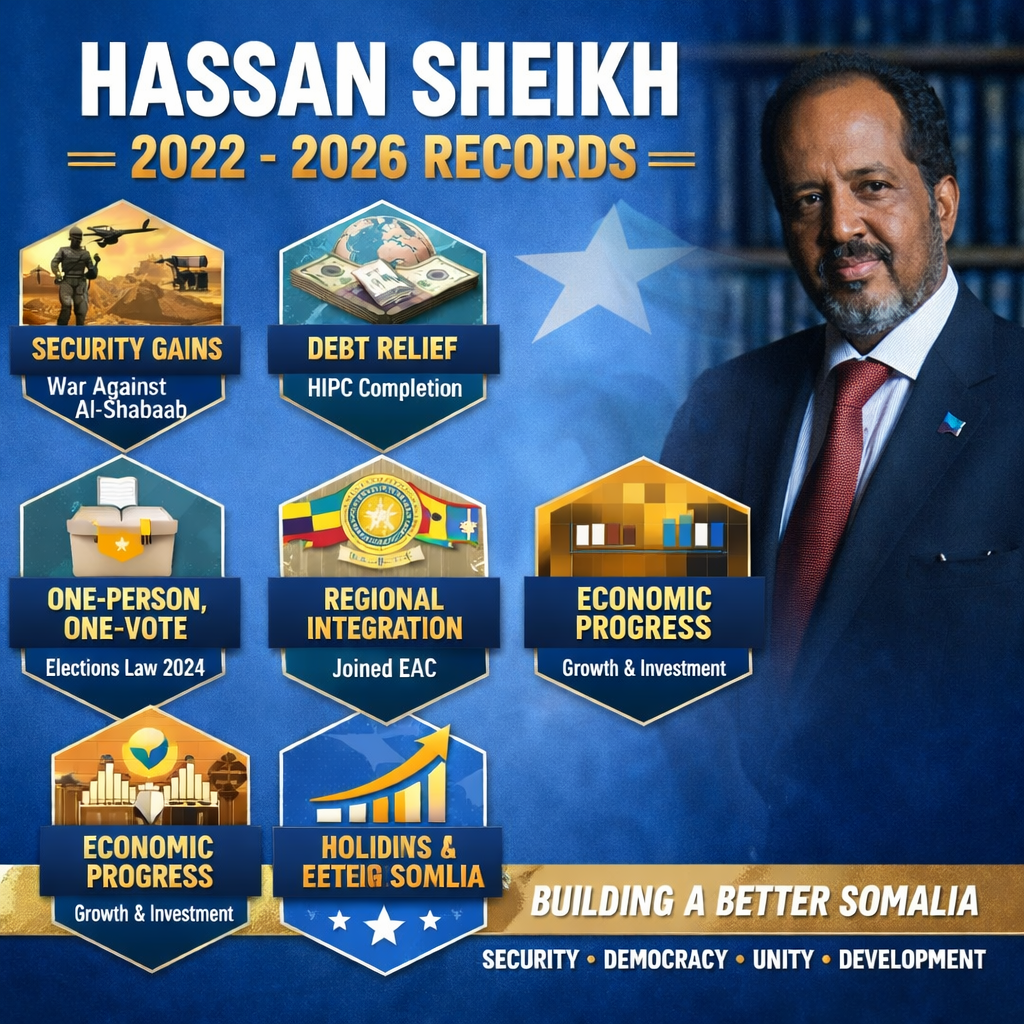
One of the most defining features of President Mohamud’s leadership has been the intensified military campaign against Al-Shabaab. Beginning in late 2022, the government partnered with local community militias particularly the Macawisley forces to reclaim territory in central regions.
This “total war” approach combined military operations, financial disruption, and ideological countermeasures, weakening the group’s operational and financial networks.
While challenges remain, especially in rural areas, the campaign has improved security in key urban centers like Mogadishu and strengthened public confidence in state institutions.
Economic Reforms and Debt Relief
Economically, Somalia has made historic progress in restoring international financial credibility. Under Mohamud’s leadership:
- Somalia secured major debt relief under the HIPC initiative, unlocking access to global financial systems.
- The government implemented public financial reforms and digital revenue systems to improve transparency and domestic revenue generation.
These reforms have laid the groundwork for long-term economic growth, attracting international partners and investment while improving public service delivery.
Political Reform and Democratization
President Mohamud’s administration has pursued ambitious political and constitutional reforms aimed at stabilizing governance:
- A new constitutional overhaul in 2026 marked a historic step toward ending Somalia’s prolonged transitional period.
- A 2024 law introduced universal suffrage, paving the way for one-person-one-vote elections for the first time in decades.
These efforts represent a major shift from clan-based electoral systems toward democratic governance and citizen participation.
Regional Integration and Diplomacy
On the international front, Somalia has re-emerged as a more active and cooperative regional player:
- The country joined the East African Community (EAC), strengthening economic and political ties in the region.
- The government adopted a foreign policy centered on “Somalia at peace with the world,” expanding diplomatic partnerships and global engagement.
This renewed diplomacy has enhanced Somalia’s global image and increased international support for its development agenda.
State-Building and Institutional Development
The administration has also prioritized institutional strengthening and federal state-building:
- Reforms focused on security sector restructuring, governance systems, and service delivery.
- Continued efforts toward national unity and federal cooperation have been central to stabilizing the country.
These initiatives aim to build a more resilient and functional Somali state after decades of fragility.
Challenges and the Road Ahead
Despite notable progress, Somalia continues to face significant challenges, including:
- Persistent security threats from Al-Shabaab
- Political tensions over electoral models and constitutional changes
- The need for deeper institutional reforms
Nevertheless, the period from 2022 to 2026 represents a critical phase of recovery and transition, with measurable gains across multiple sectors.
Conclusion
President Hassan Sheikh Mohamud’s second term has been defined by ambition and structural reform. From security offensives to economic recovery and democratic transition, Somalia has taken meaningful steps toward stability and state-building.
While the journey remains incomplete, the progress achieved during this period has positioned Somalia on a more hopeful trajectory toward peace, governance, and sustainable development.