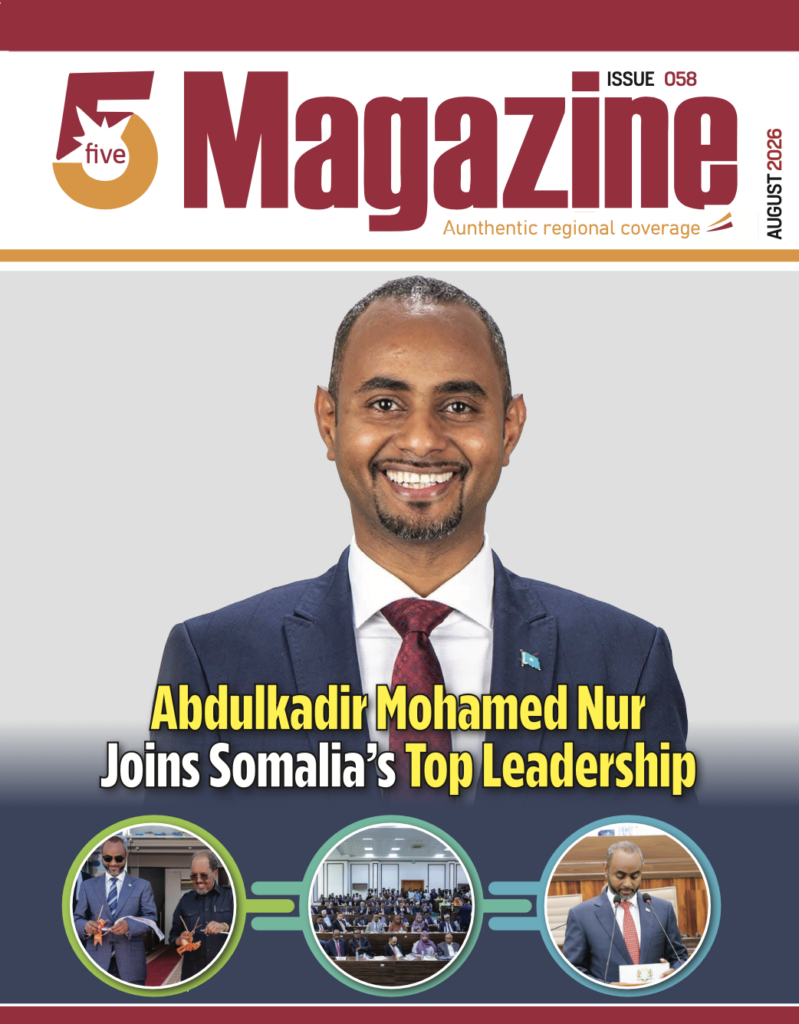
Somalia has entrusted one of its most experienced young political figures with one of the country’s most consequential constitutional offices.
On August 10, 2026, Abdulkadir Mohamed Nur was elected Speaker of the House of the People of the Federal Parliament of Somalia, bringing to the legislature a politician whose career has traversed some of the most demanding corridors of the Somali state: defence, intelligence, justice, diplomacy and maritime transport.
At 40, Nur assumes the speakership at a defining moment for Somalia. The country is attempting to consolidate fragile security gains, strengthen federal institutions, expand its economy and prepare for elections expected in less than a year. Parliament, meanwhile, must perform its constitutional functions while navigating political competition, regional interests and the demands of a country still emerging from decades of conflict.
The new Speaker therefore inherits an office that is considerably more than ceremonial. He is expected to preside over a legislature that must scrutinise government, pass laws, approve budgets, represent citizens and provide a forum for political differences to be resolved through institutions rather than confrontation.
Nur’s unusually broad experience could prove valuable.
He arrives at the helm of Parliament after serving as Minister of Ports and Marine Transport, Minister of Defence and Minister of Justice. Before entering the Cabinet, he worked in intelligence and diplomacy, including as Deputy Director of Somalia’s National Intelligence and Security Agency and as a diplomat in Türkiye.
His career has effectively followed the evolution of Somalia’s state-building project: from security and intelligence to justice and governance, then economic infrastructure and now parliamentary leadership.
From Security to the Seat of Parliament
Born on October 21, 1985, Nur belongs to a generation of Somali leaders whose professional lives have unfolded against the backdrop of the country’s long struggle to rebuild functioning state institutions.
His appointment as Speaker places that generation at the centre of Somalia’s political transition.
His immediate challenge will be to balance the competing responsibilities of Parliament at a time when the country cannot afford institutional paralysis.
Somalia’s security needs remain substantial. Al-Shabaab continues to pose a serious threat, even as Somali security forces have made advances with support from international and regional partners. At the same time, the government must address economic development, public services, infrastructure, federal relations and the political process ahead of elections.
The Speaker will sit at the intersection of many of these issues.
Parliament’s decisions on security legislation, public finance, governance, justice and electoral frameworks can have direct consequences for the country’s stability. Its debates will also provide an important measure of Somalia’s democratic maturity.
Nur’s background means few of these issues are unfamiliar to him.
As Defence Minister from December 2021 to March 2025, he was at the centre of Somalia’s military response to Al-Shabaab. He provided strategic leadership to defence institutions during one of the country’s most significant military campaigns, in which Somali forces sought to reclaim territory and strengthen the state’s presence beyond major urban centres.
That experience exposed him to the difficult realities of governing a country where security and politics remain deeply interconnected.
It also gave him first-hand knowledge of the pressures confronting the Somali National Army and the importance of cooperation with regional and international partners.
Those experiences could now influence how he approaches Parliament’s role in national security: providing legislative oversight while ensuring that security institutions have the legal and institutional support necessary to protect citizens.
A Career Built Across Institutions
Nur’s public service career began well before his ministerial appointments.
Between 2012 and 2017, he served at the Somali Embassy in Ankara, Türkiye, where he worked to advance Somalia’s diplomatic interests and strengthen bilateral relations.
The assignment was significant in another respect. He studied International Relations at Ankara University, giving him an academic and professional foundation in diplomacy and international affairs.
From 2017 to 2018, he served as Deputy Director of NISA, contributing to intelligence coordination, strategic security planning and national security operations.
His transition from diplomacy to intelligence and subsequently to ministerial office illustrates the breadth of experience he now brings to Parliament.
As Minister of Justice between 2020 and 2021, he worked on legal and institutional reforms intended to strengthen the rule of law, improve governance and advance anti-corruption efforts.
That experience may be particularly relevant to his new responsibilities. Parliament’s effectiveness depends not simply on the laws it passes, but on the strength of institutions tasked with implementing them.
A Speaker with experience in justice and institutional reform understands the importance of legislation that is practical, enforceable and consistent with constitutional principles.
From the Battlefield to the Ports
Nur’s move from Defence to Ports and Marine Transport in March 2025 represented another shift in his public career—from military security to economic infrastructure.
As Ports Minister, he led efforts to modernise Somalia’s maritime sector, improve port infrastructure and strengthen maritime transportation services.
The portfolio was central to Somalia’s ambitions to exploit its strategic location along one of the world’s most important maritime corridors.
With a long coastline on the Indian Ocean and proximity to major international shipping routes, Somalia has significant potential to develop its ports as gateways for regional and global commerce.
Nur’s stated vision was to build efficient, secure and competitive ports capable of increasing government revenue, stimulating economic activity and creating sustainable employment for Somalis.
The transition also demonstrated his understanding of security in a broader sense.
For a country emerging from conflict, economic infrastructure can be as important to long-term stability as military capability. Ports generate revenue, facilitate trade, create jobs and connect a country to the global economy.
That combination of security and development will be central to Nur’s new role.
The Speaker’s Balancing Act
The speakership will test a different set of skills.
Unlike a minister, who operates within the executive branch and implements government policy, the Speaker must manage the business of Parliament while protecting its institutional independence and ensuring that legislators can discharge their constitutional responsibilities.
This will require Nur to be both referee and institutional leader.
He will have to manage political disagreements, maintain parliamentary order and ensure that government and opposition voices receive appropriate space.
The challenge becomes more pronounced as Somalia approaches another electoral cycle.
With elections less than a year away, Parliament is likely to become an increasingly important arena for debates over the political future of the country. Questions surrounding electoral arrangements, political representation, federal relations and constitutional governance will inevitably generate competing interests.
The Speaker will need to ensure that Parliament remains a place where those disagreements are debated rather than allowed to deepen political fractures.
His security background could be both an asset and a test.
It gives him an intimate understanding of the threats facing the state, but the speakership demands a constitutional mindset in which political disagreements are handled through procedure, debate and voting.
The credibility of his tenure will therefore depend not only on what Parliament achieves, but also on whether Somalis perceive the House as fair, representative and independent.
A Parliament Under Pressure
The House of the People operates within a country where the institutions of government are still being strengthened.
For decades, Somalia’s political system was undermined by conflict and institutional fragmentation. The rebuilding of Parliament is therefore part of a much larger national project.
The legislature must help create the legal foundations for a functioning state while responding to immediate challenges confronting citizens.
That means passing laws that support security and economic growth, strengthening oversight of public resources and ensuring that government institutions remain accountable.
It also means giving citizens confidence that political disputes can be resolved peacefully.
For Nur, the challenge will be to transform his diverse executive experience into parliamentary authority without allowing his previous roles to overshadow the distinct constitutional responsibilities of the Speaker.
His success may ultimately be measured by the institution he leaves behind rather than by the number of political battles he wins.
A Diplomat at a Global Moment
Nur’s election was quickly followed by congratulations from leaders and institutions across Africa, the Arab world and beyond.
Messages of goodwill from the African Union, the Arab League, Türkiye and other international partners reflected the significance attached to Somalia’s parliamentary leadership and the country’s continuing engagement with regional and global institutions.
For Nur, the international dimension is familiar territory.
His diplomatic experience in Türkiye, his fluency in English and Turkish and his ability to communicate effectively in Arabic provide him with tools for engaging foreign governments, parliamentary institutions and international organisations.
His native Somali and multilingual abilities are particularly useful in a political environment in which domestic priorities and international partnerships are closely connected.
Somalia’s security architecture, economic development and state-building efforts depend heavily on relationships with external partners. Parliament will therefore increasingly be called upon to engage with international agreements, development partnerships, security cooperation and regional initiatives.
A Speaker who understands those relationships from both diplomatic and executive perspectives could give the legislature a stronger international voice.
The Security Question
Yet the most immediate test remains security.
The military campaign against Al-Shabaab during Nur’s tenure as Defence Minister was one of the most consequential periods in Somalia’s recent security history.
Territorial gains by Somali forces demonstrated growing capabilities, but the durability of those gains depends on the ability of the state to establish governance, provide services and sustain security after military operations.
This is where Parliament has an important role.
Legislators must scrutinise security expenditure, support appropriate legal frameworks, oversee security institutions and ensure that counterterrorism efforts remain consistent with the rule of law.
Nur’s experience places him in a unique position to understand both sides of that equation.
He knows the operational demands of national security. He also knows, from his time as Justice Minister, the importance of legal institutions and accountability.
Bringing those perspectives together could shape his approach to the speakership.
The Election Ahead
The approaching elections may ultimately define Nur’s first year in office.
An electoral period places additional pressure on Parliament and its leadership. Political actors become more assertive, public debate intensifies and institutional decisions can be interpreted through the lens of electoral competition.
The Speaker will therefore face the difficult task of ensuring that Parliament continues functioning while avoiding becoming paralysed by political campaigning.
He will need to defend parliamentary procedure, encourage substantive debate and maintain confidence across political divides.
For Somalia, the stakes are considerable.
A credible electoral process can strengthen public confidence in state institutions. A deeply contested or poorly managed process, by contrast, could compound existing political and security pressures.
Nur’s ability to maintain Parliament as a neutral constitutional forum could consequently become one of the most important tests of his leadership.
A New Chapter
The election of Abdulkadir Mohamed Nur represents a significant moment in Somalia’s evolving political landscape.
At 40, he brings an unusual combination of security, diplomatic, legal and economic experience to the speakership. He has served in the intelligence service, worked as a diplomat, led the Justice Ministry, directed the Defence Ministry and most recently overseen the country’s maritime and port sector.
Few Somali officials arrive at Parliament’s leadership with such a varied résumé.
But experience alone will not guarantee success.
The new Speaker must now move beyond the executive world of ministerial decision-making and embrace the more delicate responsibilities of parliamentary leadership. He must accommodate political differences, protect institutional independence, promote accountability and ensure that Parliament remains responsive to citizens.
He will do so against the backdrop of a country still fighting to secure its territory, rebuild its economy and deepen democratic institutions.
The coming months will test whether Nur can convert the lessons of his career into a new form of leadership—one centred not on commanding institutions, but on bringing them together.
His journey from Ankara to intelligence, from justice to the battlefield, from Somalia’s ports to the parliamentary chamber has prepared him for many of the challenges ahead.
Now, as Speaker of the House of the People, Abdulkadir Mohamed Nur faces perhaps his most demanding assignment yet: helping Somalia navigate the difficult passage between insecurity and stability, institutional fragility and resilience, and political competition and democratic consolidation.
The significance of his election will ultimately lie not merely in the office he occupies, but in what he and the Parliament he leads are able to accomplish at a pivotal moment in Somalia’s state-building journey.
For a country approaching another election and still confronting profound security and governance challenges, the new Speaker’s task is clear—and formidable: keep Parliament working, keep political dialogue alive and help ensure that Somalia’s next chapter is written through institutions rather than instability.