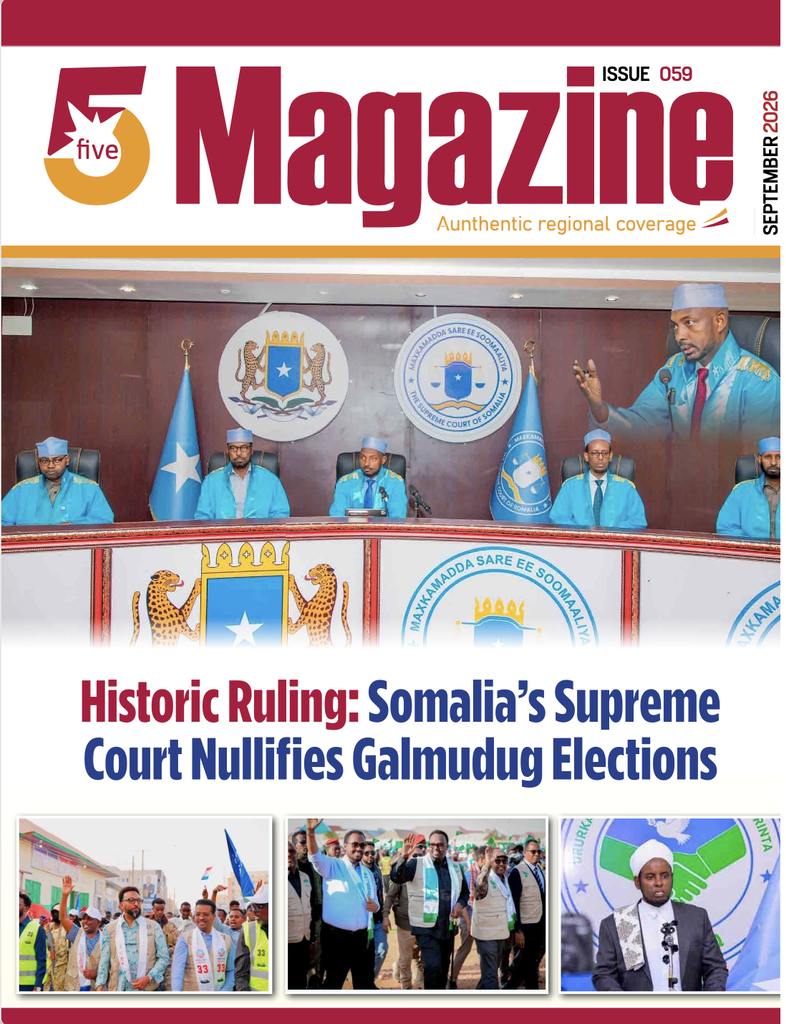
5 Magazine- Sep 2026 Edition…
Somalia’s Supreme Court has annulled the results of the recent Galmudug State parliamentary and local council elections, ruling that the polls were not conducted in accordance with the country’s Constitution and electoral law.
The decision, announced by Chief Justice Baashe Yusuf Ahmed, declared the election results void and ordered the Independent National Electoral and Boundaries Commission (NIEBC) to organise fresh elections in Galmudug.
The court said irregularities in the electoral process were serious enough to undermine the transparency, fairness and integrity of the election and affected the final outcome.
The ruling followed a petition by the Towfiiq Reconciliation and Development political organisation challenging the conduct and results of the election. The case was heard by a five-judge Electoral Division of the Supreme Court between August 17 and 19 before the ruling was delivered on August 24.
The July 30 election was held simultaneously for the Galmudug House of Representatives and local councils across 11 districts. Electoral officials reported that 197,971 people cast ballots from a registered electorate of 215,860.
The Justice and Solidarity Party (JSP), the ruling political organisation, emerged with the largest number of seats in the disputed results, securing 63 of the 89 House of Representatives seats and 115 of the local council seats. Towfiiq was allocated 12 assembly seats but disputed the results, claiming it had won 47 seats.
The party subsequently challenged the results in court and called for an independent audit of ballots from several districts.
In its ruling, the Supreme Court directed the electoral commission to conduct a fresh election “at the earliest reasonable time” and ensure that the new process complies with the Constitution, electoral law and regulations governing political organisations and parties.
The court also ordered that the existing Galmudug institutions remain in office until new officials are elected through a legally compliant process. The arrangement is intended to prevent an administrative vacuum and ensure continuity of public services while preparations for the fresh election are made.
The ruling has been welcomed by opposition political organisations, including Towfiiq and Sincad, which said they were ready to participate in a fresh election.
Towfiiq chairman Sheikh Shakir welcomed the decision and called on supporters to respond peacefully.
The ruling also received support from within the ruling political establishment. JSP candidate Liban Hassan welcomed the Supreme Court decision and said he was ready for another election. He called on residents of Galmudug to return to the ballot box and participate in the fresh vote.
Defence Minister Ahmed Fiqi also welcomed the judgment, saying the government respected the independence of the Supreme Court and would support the arrangements necessary for a new election.
“The government welcomes the decision. The Supreme Court has made an independent ruling, and the government will support the facilities needed for another election to happen as a free and fair election,” Fiqi said.
Political analyst Hassan Ali, who is based in Nairobi, said the decision was significant for Somalia’s democratic development because it demonstrated that electoral disputes could be resolved through institutions rather than political confrontation.
“The ruling is important for the growth of democracy in Somalia because it shows that no election is above the law. When a court can independently examine an electoral process and order a fresh vote where the law has not been followed, it strengthens public confidence in democratic institutions,” Ali said.
He said the willingness of political parties to accept the ruling and prepare for another election was equally important.
“The fact that both the opposition and the ruling party candidates have welcomed the decision and expressed readiness to return to the people is a positive sign. Democracy is strengthened when political actors are willing to accept institutional decisions, even when those decisions may not favour them,” Ali said.
The Galmudug ruling comes as Somalia continues its transition towards direct, one-person-one-vote elections after years in which political representation was largely determined through indirect electoral arrangements.
The country’s move towards direct elections has been accompanied by political disagreements over electoral rules, the role of federal member states and the independence of electoral institutions.
The Supreme Court’s intervention therefore carries significance beyond Galmudug.
The July 30 election was considered an important step in expanding direct participation in Somalia’s political process. Its annulment represents a setback for the electoral authorities but also provides an opportunity to correct shortcomings before voters return to the polls.
The court’s decision also establishes that electoral authorities must adhere to statutory requirements governing the conduct of elections.
Among the requirements outlined by the court are advance notification of polling dates, compliance with voter registration procedures, timely publication of voter and candidate lists, and proper declaration and publication of results.
The court held that breaches of electoral law can invalidate an election where they affect the credibility or integrity of the process and ultimately the outcome.
The decision has, however, raised questions about consistency because the same electoral commission has overseen other recent elections that were subsequently validated by the Supreme Court.
The court ratified the Banadir district council elections in March and validated South West State’s assembly and local council elections in May. Both elections were conducted under the same 2024 National Electoral Law.
The Supreme Court did not address those earlier decisions in its Galmudug ruling.
The immediate focus, however, is now on the fresh Galmudug election.
The electoral commission will be required to set a new timetable and organise the vote in accordance with the legal requirements set out by the court. No date for the fresh election has yet been announced.
For voters, political parties and candidates, the rerun will provide another opportunity to participate in the process.
For Somalia’s democratic institutions, it will be a test of whether the lessons from the annulled election can be translated into a more transparent and credible electoral process.
Ali said the next election would be particularly important because it would demonstrate whether the court’s decision could lead to practical improvements.