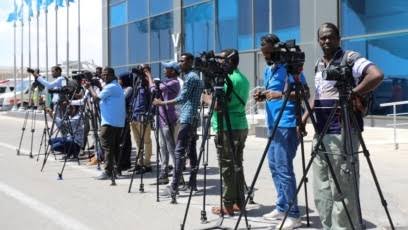
The National Union of Somali Journalists (NUSOJ) has published its latest State of the Media Report, revealing an increasingly hostile environment for journalists and media organisations across Somalia.
The report documents a pattern of persistent abuse and unchecked violations, showing that attacks on the press remain widespread and largely unpunished.Between 1 January and 31 December 2025, NUSOJ recorded 72 media freedom violations. Of these, 70 cases involved individual journalists, while two targeted media houses, indicating that both reporters and institutions are facing sustained pressure. The killing of journalist Mohamed Abukar Mohamed (Dabaashe) during the year underscores the extreme risks associated with the profession, reinforcing concerns about journalists’ safety.The data points to a strong regional concentration of violations.
Banadir region alone accounts for 39 cases, representing more than half of the total. Somaliland follows with nearly one-third of reported incidents, while the remaining violations are spread across Puntland, Galmudug, Jubaland, and Southwest states. Peaks in May and September suggest that attacks often intensify during politically sensitive periods or heightened public scrutiny.Violations documented in the report range from arbitrary arrests and intimidation to physical assaults, legal harassment, and obstruction of reporting. These incidents are frequently linked to coverage of corruption, land disputes, political tensions, and security operations.
The pattern suggests a deliberate attempt to silence critical reporting and restrict the flow of information. Security forces emerge as key perpetrators. Police, particularly in Banadir, are responsible for the majority of recorded violations. Yet despite their prominent role, there has been no meaningful accountability.
The absence of investigations or prosecutions has entrenched a culture of impunity, allowing abuses to persist unchecked.The report also sheds light on the precarious conditions under which journalists work. Low or non-existent wages, often below $100 per month, combined with the lack of contracts and labour protections, leave journalists vulnerable to exploitation and external pressure. These conditions not only affect their livelihoods but also compromise editorial independence and journalistic standards. Women journalists face heightened challenges.
NUSOJ recorded 29 cases of sexual and gender-based violence, occurring both within media workplaces and online. These violations, often driven by intimidation and discrimination, contribute to the marginalisation of women in journalism and limit diverse representation in the media.Legal constraints further compound the situation.
The continued reliance on the 1964 Penal Code, along with restrictive provisions in the 2020 Media Law and the expansive use of anti-terrorism legislation, has enabled authorities to criminalise journalistic work, particularly on sensitive political and security issues.NUSOJ cautions that the erosion of media freedom has broader implications for Somalia’s democratic development, Restrictions on journalism undermine transparency, weaken accountability, and limit citizens’ access to reliable information, ultimately affecting governance and public trust.In response, NUSOJ is calling for urgent and concrete measures, including independent investigations into violations, prosecution of perpetrators, legal reforms to protect press freedom, and improved working conditions for journalists.
It also urges the full implementation of the National Action Plan on the Safety of Journalists adopted in 2022. Without sustained action, the report warns, Somalia risks further deterioration of press freedom, with serious consequences for democratic progress, stability, and the protection of fundamental rights.