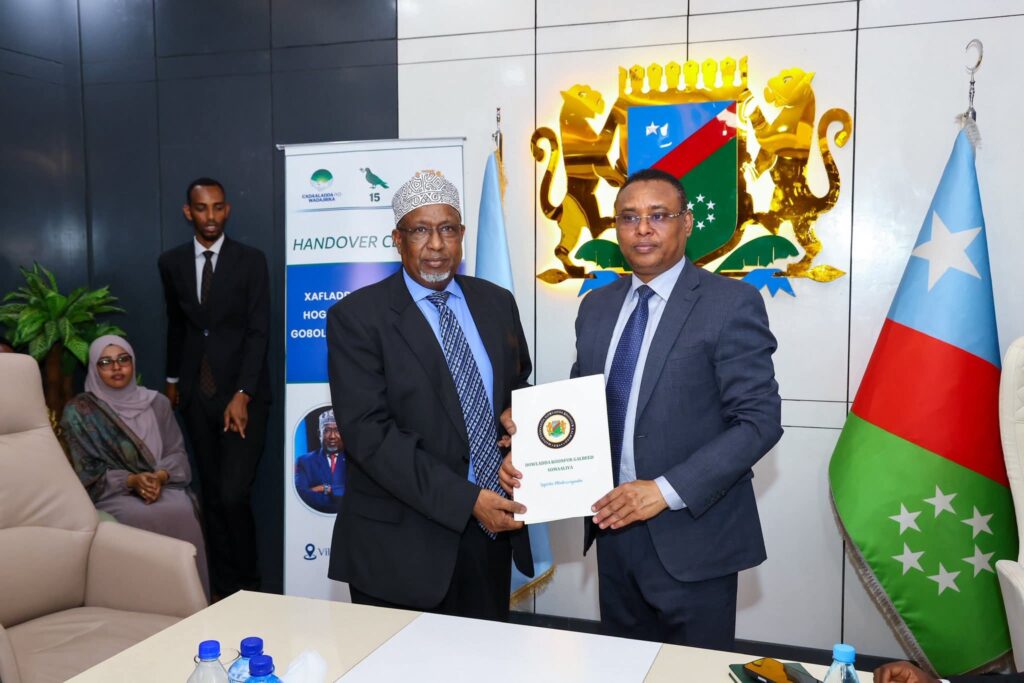
The election of Sheikh Aden Mohamed Nur “Aden Madobe” as the new leader of the Southwest State of Somalia marks more than a change in regional leadership. It represents a significant milestone in Somalia’s democratic journey and a powerful demonstration of the country’s growing commitment to representative governance.
On June 10, in the city of Baidoa, lawmakers overwhelmingly elected Aden Madobe as President of the Southwest State for the next five years. Madobe secured 88 votes, while his challenger, Abdiaziz Mohamed Jawari, received one vote, according to official election results. While the landslide victory itself attracted national attention, the real significance of the election lies in the unique democratic process that made it possible.
From Citizens to Parliament to President
For the first time in Somalia’s federal history, a regional state leader has been elected by lawmakers who themselves were chosen directly by the people through one-person-one-vote elections. This historic achievement is being celebrated as a major success in Somalia’s ongoing efforts to strengthen democratic governance and move away from indirect electoral systems that have dominated the country’s politics for decades.
The process began on May 10, when citizens across Southwest State went to the polls to elect their local representatives in elections organized by Somalia’s National Independent Electoral and Boundaries Commission (NIEBC).
The elections were officially launched by NIEBC Chairman Abdikarim Ahmed Hassan, who oversaw the opening of polling stations where citizens cast their votes for representatives of their choosing.
For many voters, it was a landmark moment. Ordinary citizens were no longer observing political decisions from a distance; they were actively shaping the composition of the institutions that would govern them.
On May 25, the commission announced the official results, confirming the election of local lawmakers chosen directly by voters. Those elected representatives then selected the leadership of the regional parliament. The newly formed parliament subsequently held the presidential election, which resulted in Aden Madobe’s victory.
The sequence created an unprecedented democratic chain: citizens elected representatives, representatives elected parliament leadership, and parliament elected the regional president.Political observers have described the process as a major step toward institutionalizing democratic governance at the regional level.
A Victory for Democratic Reform
The successful implementation of one-person-one-vote elections in Southwest State is widely viewed as one of the most important political achievements in recent years. For the Federal Government of Somalia, the process serves as a proof of concept that democratic elections can be organized successfully and peacefully despite the country’s complex political landscape.
The achievement aligns with broader national efforts to expand direct elections across Somalia and eventually establish universal suffrage at the federal level. Government officials and political analysts alike see Southwest State as a model that could be replicated in other federal member states as Somalia continues its democratic transformation.
The successful conduct of the elections has reinforced confidence in national institutions and demonstrated growing public trust in democratic processes. Perhaps most importantly, it has shown that Somali citizens are eager to participate in shaping their political future when given the opportunity.
Presidential Recognition
President Hassan Sheikh Mohamud praised the democratic process and congratulated Aden Madobe on his victory. The President commended the maturity demonstrated by lawmakers, parliamentary leaders, election officials, and presidential candidates throughout the electoral process.
He also extended his best wishes to the newly elected leader as he assumes responsibility for guiding Southwest State through its next chapter.
“I congratulate the new leader of Southwest State, Mr. Sheikh Aden Mohamed Nur, on his victory in the elections held in the region,” President Hassan Sheikh said. “I hope he will focus on uniting the people of Southwest State and work toward peace, development, and stronger governance.”
The President highlighted the importance of the interconnected elections that enabled citizens to participate directly in choosing their representatives. According to President Hassan Sheikh, the elections have opened a new chapter in Somalia’s democratic history by demonstrating political maturity, civic awareness, and the Somali people’s commitment to building a democratic system based on free and fair elections.
He further praised the hundreds of thousands of citizens who participated peacefully in the voting process, noting that their patience, determination, and civic responsibility reflected growing confidence in state institutions and Somalia’s democratic future.
Aden Madobe’s Vision for Southwest State
Speaking after the announcement of the results, Aden Madobe expressed gratitude to lawmakers for their overwhelming support and outlined his priorities for the coming years.
“I am grateful for the confidence placed in me by the members of parliament,” he said. “My priority will be to promote unity among our people, advance reconciliation efforts, and build stronger democratic institutions.”
These priorities are expected to guide his administration as it works to strengthen regional governance while contributing to Somalia’s broader nation-building efforts.
A Veteran Statesman Takes the Helm
Aden Mohamed Nur Madobe brings decades of political experience to his new position. Widely known as Aden Madobe, he currently serves as Speaker of the House of the People in Somalia’s Federal Parliament, a position he has held since April 2022.
Throughout his long political career, he has occupied several senior leadership positions during key periods in Somalia’s modern history.
Madobe previously served as First Deputy Chairman of the Rahanweyn Resistance Army before joining Somalia’s Transitional Federal Government. He later held the positions of Minister of Justice and Speaker of the Transitional Federal Parliament.
Between December 2008 and January 2009, he briefly served as the Acting President of Somalia during a transitional period. In 2014, he was appointed Minister of Industry and Commerce, further expanding his experience in government administration and national leadership.
Born in Hudur, the capital of Bakool Region, Madobe has remained one of the country’s most influential political figures for more than two decades. His extensive experience at both federal and regional levels is expected to play an important role as Southwest State pursues development, security, and governance reforms.
A Model for Somalia’s Future
The significance of Aden Madobe’s election extends beyond the Southwest State. The process that brought him to office has become a symbol of Somalia’s democratic aspirations and the gradual transition toward a political system based on direct citizen participation.
For years, Somalia’s leaders have spoken about the goal of implementing one-person-one-vote elections nationwide. The successful experience in Southwest State provides tangible evidence that this vision can be achieved.
By allowing citizens to directly choose their representatives and creating a legitimate electoral pathway from voter to parliament to president, Southwest State has provided a glimpse of what Somalia’s democratic future could look like. For many observers, that may be the most important victory of all.