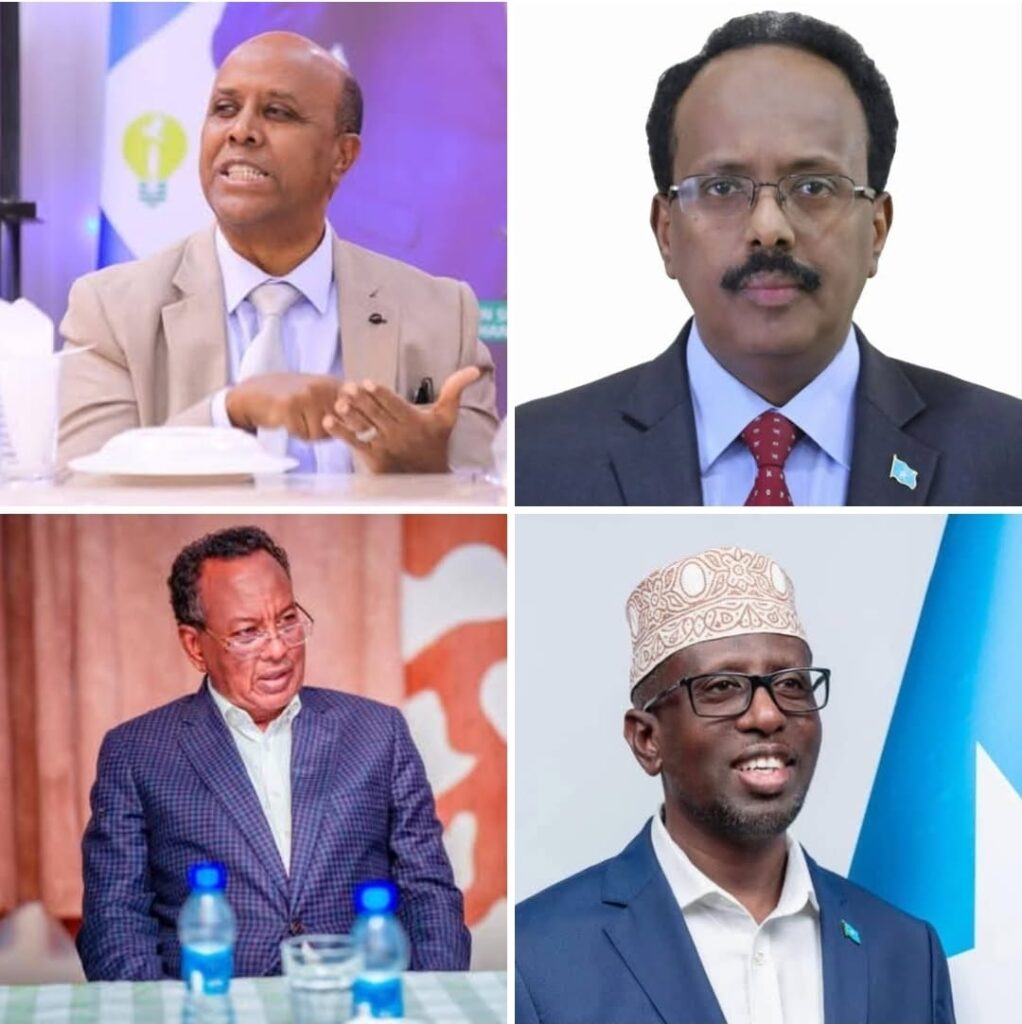
Somalia’s next presidential election may still be on the horizon, but the political chessboard is already taking shape. As speculation grows over who could succeed President Hassan Sheikh Mohamud, four names continue to dominate conversations in Mogadishu’s political circles: former presidents Mohamed Abdullahi Farmaajo and Sharif Sheikh Ahmed, former Prime Minister Abdi Farah Shirdon (Saacid), and businessman Omar Abdulkadir Ahmed Fiqi.
Each offers a different vision for a country still battling insecurity, political fragmentation and economic hardship.
Farmaajo remains one of Somalia’s most recognisable political figures. His presidency was built on a strong nationalist agenda, a push for a powerful central government and a message of protecting Somalia’s sovereignty. Those qualities continue to resonate with many young Somalis and supporters who believe the country needs decisive leadership.
But his critics argue that his tenure also deepened tensions between the federal government and regional states, leaving behind political divisions that continue to shape Somalia’s governance. Even so, few doubt his ability to mobilise supporters or mount a serious comeback.
Sharif Sheikh Ahmed presents a contrasting political style. Widely viewed as a consensus builder, he earned praise for steering Somalia through one of its most turbulent periods while engaging political rivals, religious leaders and international partners. At a time when political dialogue is increasingly seen as essential, Sharif could appeal to those seeking compromise over confrontation.
Former Prime Minister Abdi Farah Shirdon, popularly known as Saacid, represents a quieter but potentially significant option. Drawing from both business and government experience, he has positioned himself as a technocratic leader focused on improving public administration, strengthening the economy and supporting private-sector growth. His challenge will be building the broad political alliances needed to compete against better-known rivals.
The wildcard could well be businessman Omar Abdulkadir Ahmed Fiqi. Unlike his competitors, his appeal lies largely outside traditional politics. Supporters see him as a development-focused leader capable of attracting investment, creating jobs and modernising public services. His emphasis on strengthening cooperation between the federal government and regional states could also resonate in a country where power-sharing remains a delicate issue.
Still, translating success in business into national political leadership is no easy task. Somalia’s indirect presidential election rewards political negotiation as much as public popularity, meaning Fiqi would need to win the confidence of parliamentarians, regional leaders and key political stakeholders.
Whoever eventually emerges victorious will inherit a daunting agenda. Defeating Al-Shabaab, completing constitutional reforms, fighting corruption, improving relations between Mogadishu and the Federal Member States, and creating jobs for millions of young people remain among Somalia’s biggest challenges.
The next election is therefore shaping up as more than a contest between personalities. It is a choice between competing leadership models—nationalism, reconciliation, technocratic governance and private sector-driven development.
For Somalia, the winner will not simply be the politician with the loudest campaign or the biggest political name. Success will depend on who can build the broadest coalition, inspire confidence across Somalia’s complex political and clan landscape, and convince both parliament and citizens that they have a credible plan to deliver security, stability and economic progress.
The sentiment of Somali people in the expected elections is real leadership change that has the vision needed to address the myriad challenges facing Somalia. Political recycling of old political class is not the solution to the popular opinion of the gebmberal public.