On June 11, Jowhar became the stage for one of the most significant demonstrations of state-building and development in recent Somali history. In a day marked by the inauguration of major infrastructure projects, the opening of modern government institutions, and a far-reaching national political address, the city showcased the growing momentum of Hirshabelle State and its expanding role in Somalia’s broader journey toward stability, prosperity, and democratic progress.
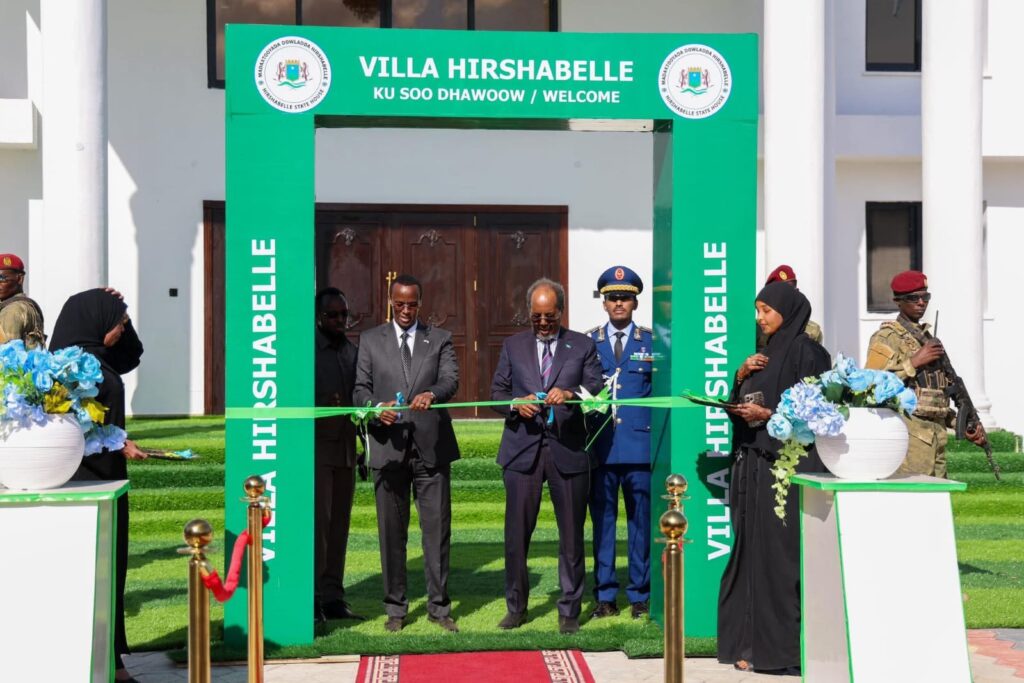
Leading the historic visit was the President of the Federal Republic of Somalia, Hassan Sheikh Mohamud, who arrived in Jowhar accompanied by Hirshabelle State President Ali Abdullahi Hussein (Ali Guudlaawe). Together, they inaugurated a portfolio of landmark projects that many observers regard as a defining moment in Hirshabelle’s development journey.
The projects officially opened included Villa Hirshabelle, the newly constructed headquarters of the Ministries of Education and Finance, and three major roads, Horseed Road, Hanti-wadaagRoad, and Jowhar-Bile Road. Collectively, these investments represent a substantial advancement in infrastructure, governance, and public service delivery, while reinforcing Hirshabelle’s ambition to become one of Somalia’s leading Federal Member States.
The inauguration marks one of the most important infrastructure milestones in the history of Hirshabelle. More than a collection of new buildings and roads, the projects symbolize a long-term vision focused on strengthening institutions, improving services, stimulating economic growth, and creating opportunities for citizens.
Among the most prominent developments was the official opening of Villa Hirshabelle, the state’s new presidential complex. Designed as the official seat of the presidency, the modern facility stands as a visible representation of the state’s determination to build effective, durable, and professional institutions capable of serving future generations.
The new headquarters for the Ministries of Finance and Education further reflect this commitment to institutional development. These facilities provide government departments with dedicated working environments, enabling them to operate more efficiently and deliver services more effectively to the public.
For years, many public institutions across Somalia functioned under challenging conditions, often lacking permanent facilities and adequate infrastructure. The completion of these modern government offices demonstrates how far Hirshabelle has progressed in its efforts to establish a stronger administrative foundation.
Former Prime Minister Prof. Ali Mohamed Gedi highlighted this transformation, noting that government institutions that once operated from makeshift facilities are now housed in purpose-built offices designed to support long-term public service delivery. The shift represents a significant step in the professionalization of governance and administration within the state.
Equally important were the transportation projects unveiled during the visit. The opening of Horseed Road, Hanti-wadaag Road, and Jowhar-Bile Road represents a major investment in connectivity and mobility throughout the capital.
The newly completed Hanti-Wadaag Road is particularly significant for the region’s economy. By connecting agricultural communities more effectively to markets, the road is expected to reduce transportation challenges, facilitate trade, and strengthen economic activity throughout the region.
Residents are also expected to benefit from improved access to government services, educational institutions, healthcare facilities, and commercial opportunities. Better roads often serve as catalysts for broader economic development, and local leaders believe these projects will help unlock new opportunities for businesses and communities alike.
Speaking during the inauguration ceremony, President Hassan Sheikh Mohamud praised the Hirshabelle administration for its commitment to development and the successful implementation of projects that directly benefit the public.
He noted that the visible progress being made in Hirshabelle demonstrates the increasing capacity of Somalia’s Federal Member States to deliver meaningful results and contribute to national development and stability. The President commended the state’s investment in infrastructure and governance, emphasizing that strong institutions and modern public facilities are critical pillars for sustainable development and long-term prosperity.
For President Ali Guudlaawe, the day represented both a celebration of achievements and a reaffirmation of future ambitions.
“This milestone is part of what Hirshabelle is focusing on, development and making the state one of the best-performing Federal Member States in Somalia,” President Ali Guudlaawe said.
His administration has made development a central priority, focusing on infrastructure, public services, education, economic growth, and institutional strengthening. During the ceremonies, he announced that additional major projects are already under implementation and will be unveiled in the coming months as part of the government’s broader modernization agenda.
The state’s educational investments have been particularly noteworthy. According to Minister of Education Said Hagar Hagaley, the newly inaugurated ministry headquarters will support educational services reaching more than 100,000 students.
Beyond the ministry building itself, the administration has overseen the construction of 23 new schools stretching from Mataban to Balcad, while 11 existing schools have undergone full rehabilitation. An additional 15 schools have benefited from expanded classroom capacity, creating improved learning opportunities for thousands of young people.
These achievements reflect a growing recognition that education remains one of the most important foundations for long-term development. By investing in schools, facilities, and educational administration, Hirshabelle is helping to prepare a new generation of citizens equipped to contribute to the region’s future growth.
The Ministry of Finance headquarters represents another important milestone. Minister of Finance Cabdiraxiin Ciise Caddow explained that the modern two-story facility contains 18 offices and two conference halls designed to enhance financial management and revenue administration.
The improved institutional capacity is expected to strengthen fiscal governance, improve efficiency, and create a more favorable environment for investment and economic expansion. Strong financial institutions are widely viewed as essential components of sustainable development, enabling governments to plan, implement, and maintain public services more effectively.
The day’s events also highlighted the broad support behind Hirshabelle’s development agenda.Senior federal and state officials, members of parliament, traditional elders, business leaders, and residents gathered in Jowhar to witness what many described as a transformative moment for the state.
Former Mayor of Mogadishu, Mohamed Osman Ali Maxamed, publicly commended the visible progress taking place across the region. Former National Intelligence Chief General Abdirahman Turyare noted that the successful implementation of large-scale projects demonstrates both improved security and institutional growth.
Political figure Muhyaden Sabey emphasized the importance of cooperation between the administration and local communities, describing citizen participation and self-reliance as key drivers of success.
Meanwhile, Chairman of the Somali Chamber of Commerce Abdikariin Gabeyre encouraged the private sector to take advantage of emerging opportunities in Jowhar, particularly within the city’s historically important agricultural and industrial sectors. His call reflected growing optimism about the region’s economic potential and its attractiveness to investors seeking opportunities in Somalia’s evolving economy.
As the official ceremonies concluded, President Hassan Sheikh Mohamud joined President Ali Guudlaawe for an official dinner hosted at the newly inaugurated Villa Hirshabelle. The gathering provided an opportunity not only to celebrate the day’s achievements but also to discuss the broader future of Somalia.
It was during this visit that President Hassan Sheikh delivered one of his most significant political addresses, outlining a vision for Somalia’s democratic future and calling for a transition away from clan-centered politics toward a modern, issue-based political system.
Addressing political leaders, officials, and guests in Jowhar, the President highlighted what he described as a contrast between Somalia’s rapidly improving physical infrastructure and the need to modernize its political framework.
“The only thing wrong with Somalia is the politics; we must move beyond personalized politics,” President Hassan Sheikh stated.
Reflecting on Somalia’s political evolution, he observed that the country had moved from the era of warlords to a system heavily reliant on traditional clan structures. While acknowledging the role these systems have played, he argued that Somalia’s continued development requires a more mature democratic model.
“As a society, we need to progress as a nation. We need the politics of parties, just like civilized nations,” he affirmed.
The President outlined a vision centered on universal suffrage and direct citizen participation in governance. Under such a system, political leaders would compete based on policies, ideas, and public support rather than traditional power arrangements.
In his words, a future candidate “needs to be part of a political party with a known manifesto, sell it to the public, and go to the public to plead for a vote directly”.
“We need to institutionalize the political process and move away from the current chaos,” he concluded.
As President Hassan Sheikh Mohamud concluded his regional tour, he laid foundation stones for additional projects planned for the future, ensuring that the momentum generated in Jowhar would continue beyond the day’s ceremonies.
For many residents, leaders, and observers, June 11 will be remembered as more than a day of inaugurations. It was a demonstration of what coordinated leadership, institutional investment, and community partnership can achieve.