He said his administration, which assumed office in December 2024, inherited significant challenges, including economic strain, drought impacts, insecurity in eastern regions and recurring clan disputes.On security, President Cirro outlined measures taken to strengthen the country’s defence capabilities. He said 6,000 newly trained soldiers had been integrated into the national forces, alongside reforms aimed at improving welfare and efficiency. These include the introduction of a mobile-based salary payment system and the establishment of a pensions framework for military personnel, described as a first in over three decades.“Our journey toward peace, stability and full international recognition is irreversible. We remain committed to strengthening our institutions, safeguarding our sovereignty and expanding opportunities for our people.”He added that the government had enhanced military training, acquired new equipment, set up a Cyber Security Unit and completed a national military data centre. Authorities have also banned the private sale of military uniforms and equipment to improve accountability.
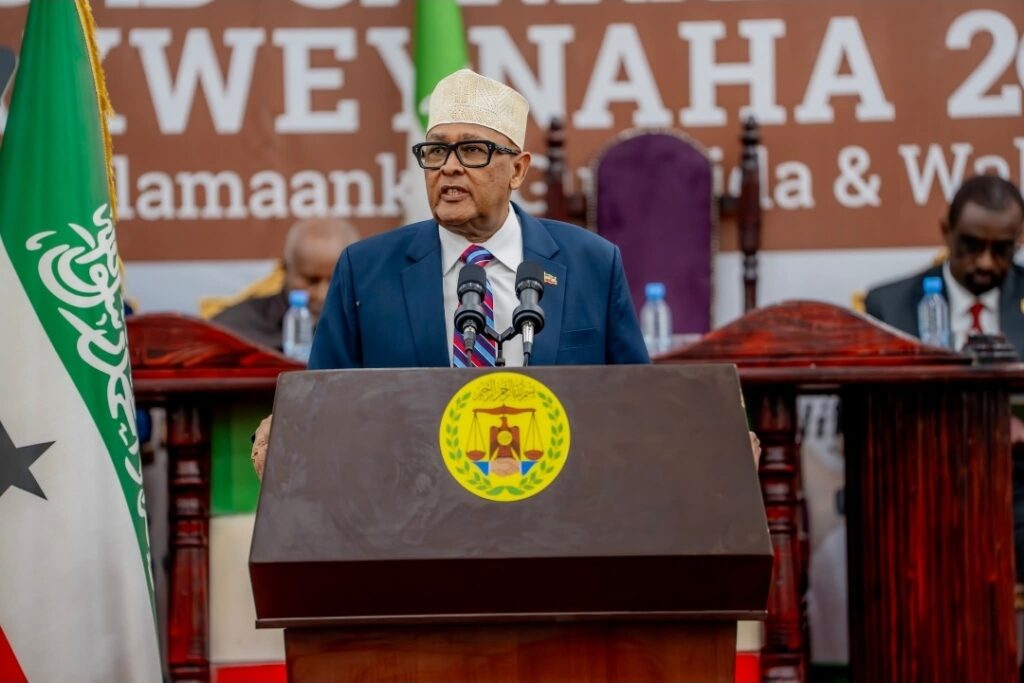
Somaliland President Abdirahman Mohamed Abdullahi Cirro has set out an ambitious agenda focused on security, governance reforms, economic growth and international recognition during his annual constitutional address to Somaliland’s Parliament.Speaking before a joint sitting of lawmakers, the President described Somaliland as a stable and democratic within the Horn of Africa, noting that the country has maintained peace and institutional continuity despite economic and security pressures.
The President emphasised the importance of internal peace, calling for dialogue and reconciliation in areas affected by conflict. He cited progress in Sanaag and ongoing efforts in Sool, including Las Anod, expressing optimism that disputes can be resolved through engagement. At the same time, he warned against actions that could escalate tensions.On governance, President Cirro reiterated his administration’s commitment to strengthening public institutions, improving service delivery and tackling corruption. He identified abuse of office and misuse of public resources as key challenges and pledged to reinforce legal and institutional safeguards.Addressing crime, he highlighted concerns over drug abuse and violent offences, particularly among young people aged between 15 and 25. He called for greater collaboration between families, educators, religious leaders and the state to address the issue, while noting improvements in policing outcomes, including reduced road accidents and killings.The President also reaffirmed his government’s commitment to electoral processes, cautioning that delays could undermine democratic gains.
He indicated that Parliament would soon receive recommendations from the National Electoral Commission on the way forward.On constitutional reform, he announced plans to establish a technical committee to review the Constitution and address emerging governance needs. He also pledged to conduct a national census to support planning and equitable representation.Economically, President Cirro described 2025 as a year of recovery. He cited increased trade through Berbera Port, growth in livestock exports to Gulf markets and expansion in fisheries and mineral exports. He said fiscal reforms, including the introduction of a Treasury Single Account, had improved financial management.He further highlighted developments in agriculture, infrastructure, water access, energy and digital systems, including the expansion of fibre-optic networks and plans for e-government services.In foreign policy, President Cirro underscored Somaliland’s pursuit of international recognition as a top priority. He noted increased diplomatic engagement at high levels compared to previous administrations and announced that Israel had formally recognised Somaliland, expressing confidence that other countries could follow.
He called for unity in advancing this agenda and strengthening Somaliland’s position globally. In remarks on regional relations, he urged authorities in Somalia to acknowledge Somaliland’s status, stating that future engagement should be based on peaceful coexistence and mutual respect.Recent diplomatic gains, including reports of recognition from influential international partners, have further strengthened national optimism. These developments are being viewed as an important milestone in Somaliland’s long-standing pursuit of global recognition and legitimacy.Together, these strides have reinforced a renewed sense of hope among citizens, with many expressing confidence that Somaliland is entering a new chapter of stability, opportunity and international engagement under his leadership.